The Problem
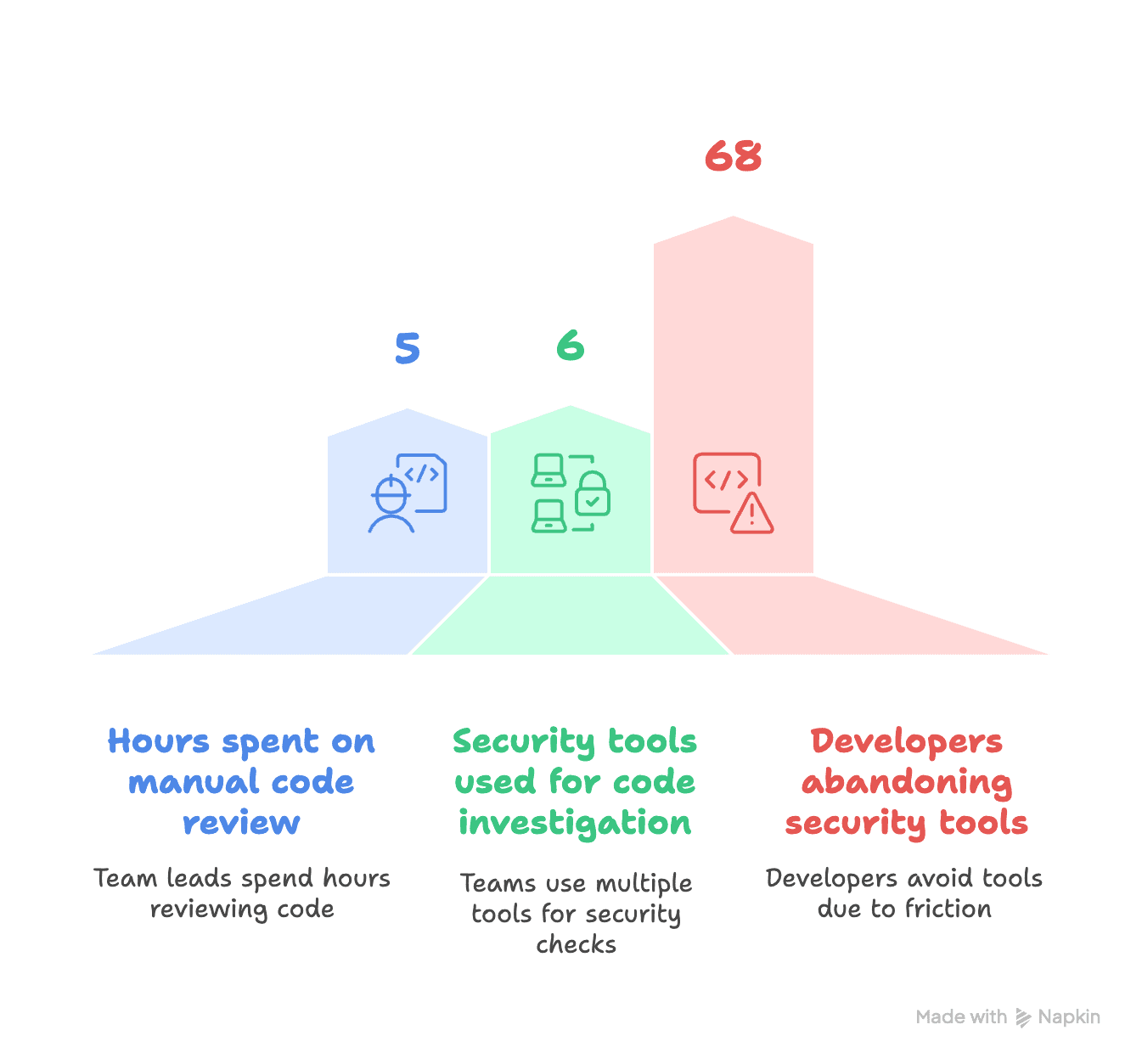
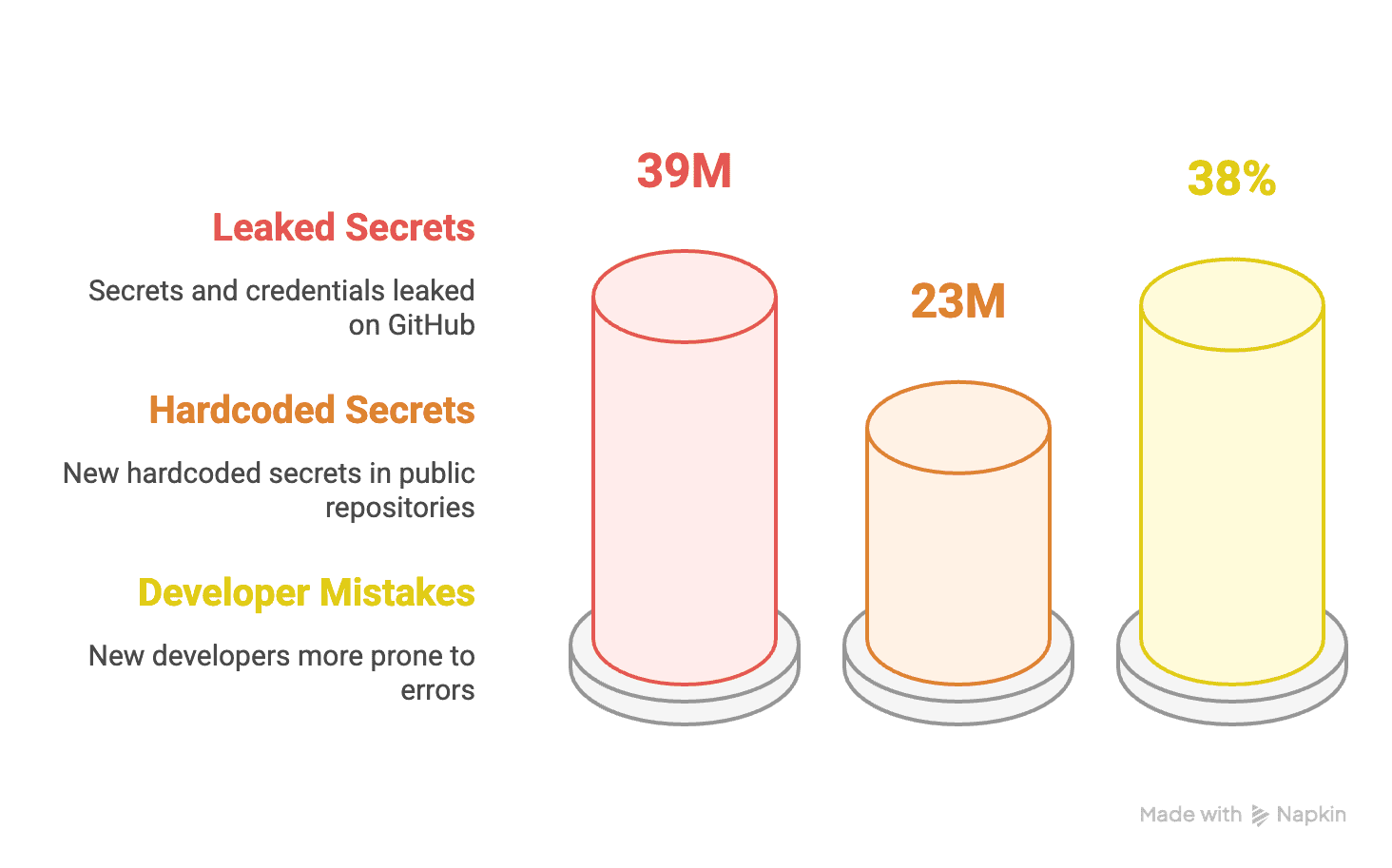
Development teams frequently leaked API keys, tokens, and credentials in GitHub repositories, leading to a $3.2B industry-wide security risk. Most existing tools flagged issues only after code was merged, making remediation expensive ~14x costlier than during review. With 68% of developers abandoning security tools due to context-switch friction and false positives, organizations lacked both prevention and visibility, risking compliance breaches, lost deals, and mounting breach costs averaging $4.45M per incident.
The Solution
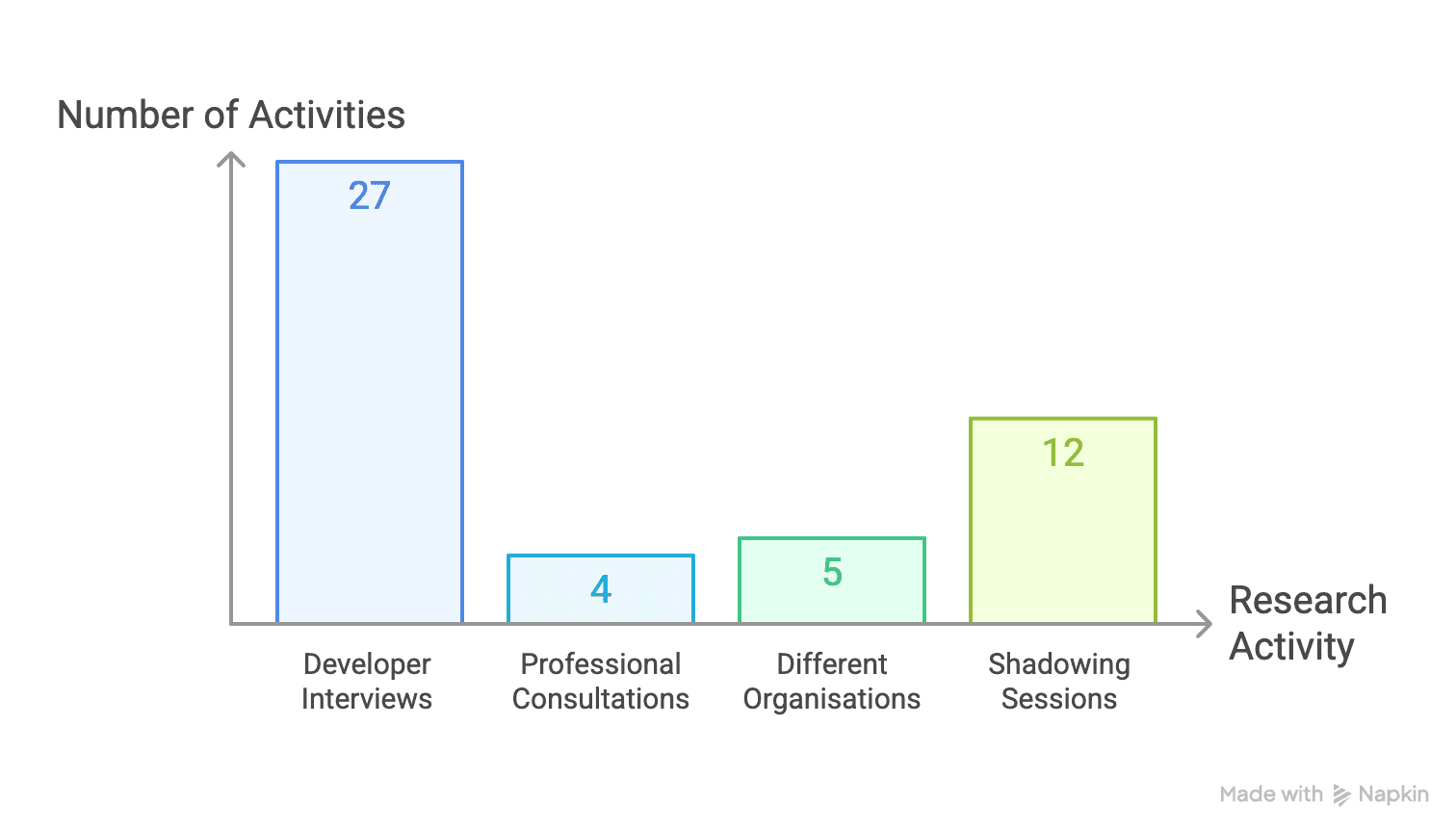
I designed SecureFlow, a GitHub-native plugin for real-time secret detection within pull request workflows. Backed by insights from 27 developer interviews and 12 workflow shadowing sessions, the solution featured inline alerts, guided remediation, and a team lead dashboard. It eliminated context switching, provided passive education, and prioritized developer velocity, delivering security without sacrificing usability. The interface also enabled coaching over micromanagement through pattern recognition and escalation.
The Outcome
SecureFlow reduced unresolved secrets by up to 45% and false positives by 70%, while cutting pull request review time by 20%. Developer engagement rose due to sub-2-minute resolution times and seamless GitHub integration. For team leads, audit trail automation and visibility into risky patterns saved over 5 hours per week. The solution positioned security as a quality gate enhancing trust, reducing risk, and promoting long-term secure development habits across teams.
The Problem
Development teams frequently leaked API keys, tokens, and credentials in GitHub repositories, leading to a $3.2B industry-wide security risk. Most existing tools flagged issues only after code was merged, making remediation expensive ~14x costlier than during review. With 68% of developers abandoning security tools due to context-switch friction and false positives, organizations lacked both prevention and visibility, risking compliance breaches, lost deals, and mounting breach costs averaging $4.45M per incident.
The Solution
I designed SecureFlow, a GitHub-native plugin for real-time secret detection within pull request workflows. Backed by insights from 27 developer interviews and 12 workflow shadowing sessions, the solution featured inline alerts, guided remediation, and a team lead dashboard. It eliminated context switching, provided passive education, and prioritized developer velocity, delivering security without sacrificing usability. The interface also enabled coaching over micromanagement through pattern recognition and escalation.
The Outcome
SecureFlow reduced unresolved secrets by up to 45% and false positives by 70%, while cutting pull request review time by 20%. Developer engagement rose due to sub-2-minute resolution times and seamless GitHub integration. For team leads, audit trail automation and visibility into risky patterns saved over 5 hours per week. The solution positioned security as a quality gate enhancing trust, reducing risk, and promoting long-term secure development habits across teams.
Developers need real-time, contextual secret detection that integrates naturally into their existing pull request workflow without breaking productivity. While team leads need to have a comprehensive dashboard that provides visibility into team security patterns, enables proactive coaching opportunities, and maintains audit compliance without micromanaging individual developers.
Market Opportunity Analysis
Market Opportunity Analysis
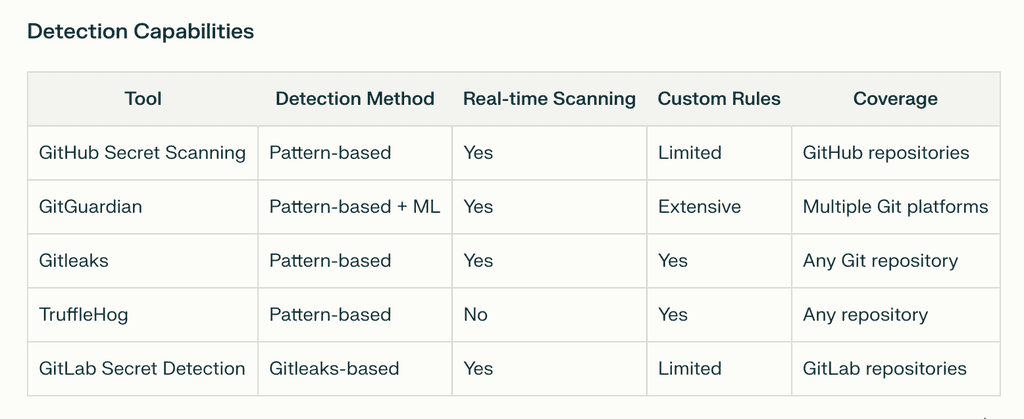
Developer security tools market in 2024 revealed a rapidly evolving but fragmented landscape.
Developer security tools market in 2024 revealed a rapidly evolving but fragmented landscape.
Contextual Intelligence: Advanced ML models that understand code context to reduce false positives by 60-70%
Seamless GitHub Integration: Native pull request workflow integration without context switching
Developer-Centric UX: Security guidance that enhances rather than interrupts development velocity
Educational Layer: Passive security education that improves long-term developer practices
Contextual Intelligence: Advanced ML models that understand code context to reduce false positives by 60-70%
Seamless GitHub Integration: Native pull request workflow integration without context switching
Developer-Centric UX: Security guidance that enhances rather than interrupts development velocity
Educational Layer: Passive security education that improves long-term developer practices
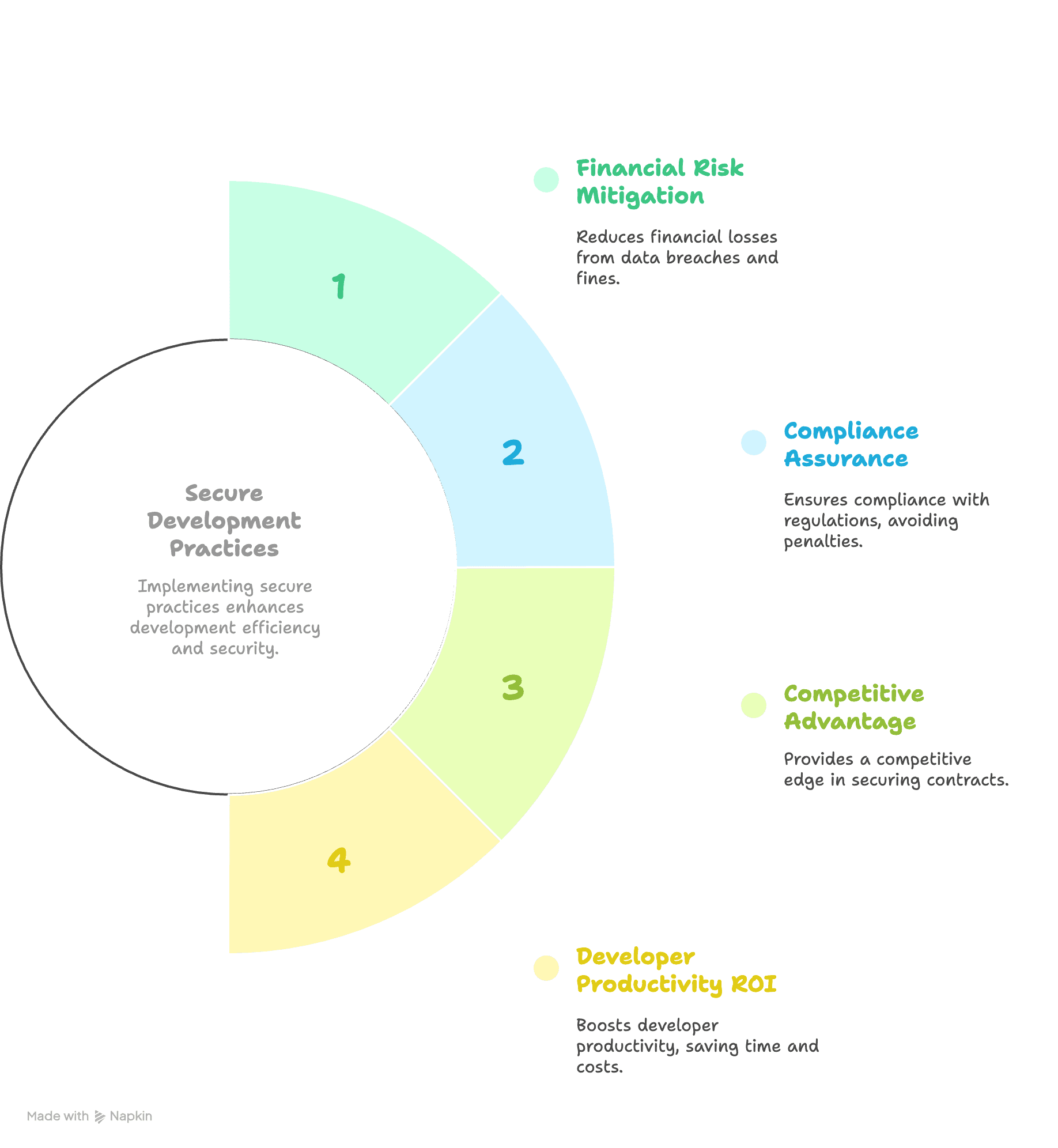
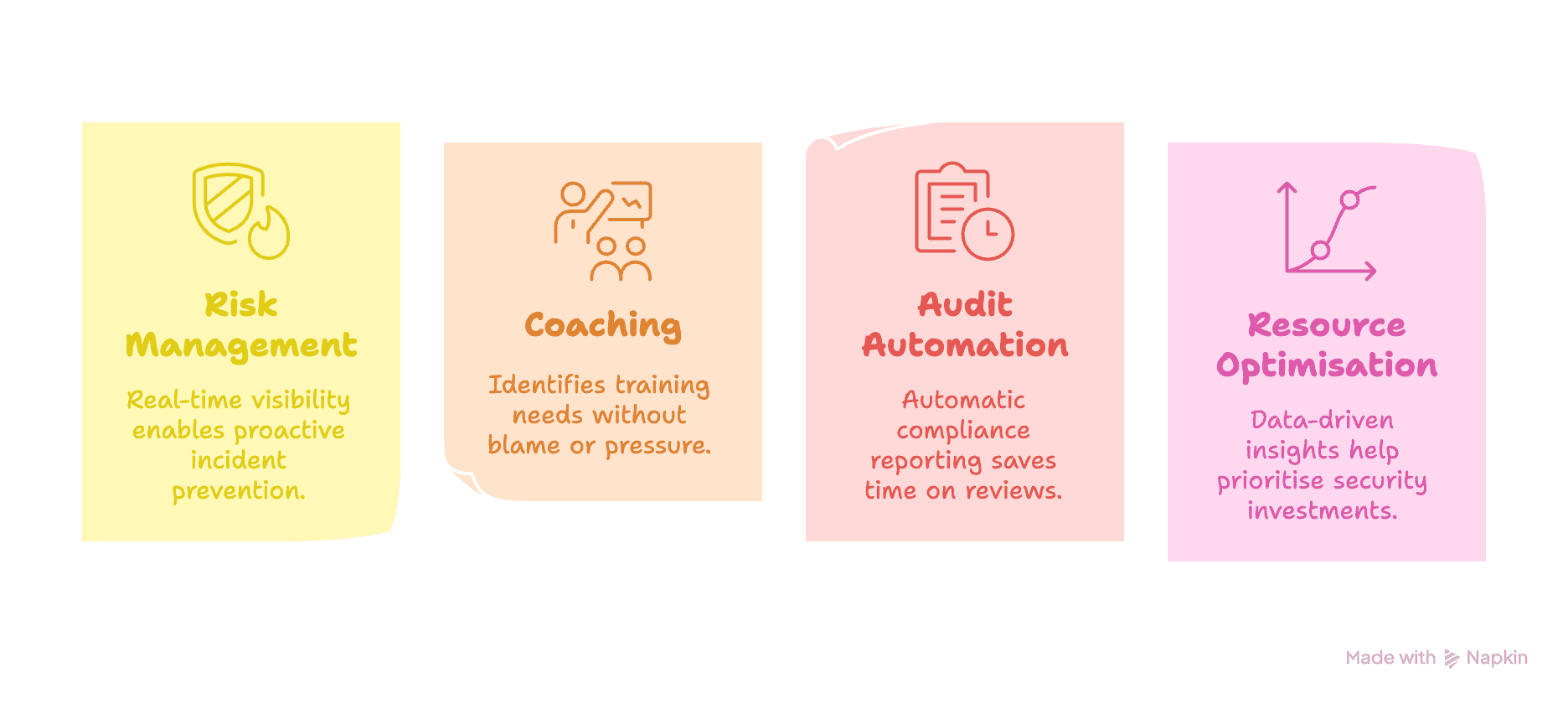
Reduce security incident costs and compliance risks: Prevent expensive post-production secret leaks that cost 14x more to remediate, while ensuring SOC 2, PCI DSS, and regulatory compliance to avoid penalties and maintain enterprise partnerships.
Increase developer tool adoption and platform stickiness: Drive higher engagement with security tools by eliminating workflow friction, leading to better security posture and reduced churn from development teams abandoning cumbersome solutions.
Enable scalable security governance across engineering organisations: Provide automated oversight and reporting capabilities that scale with team growth, reducing manual security review overhead while maintaining comprehensive audit trails.
Reduce security incident costs and compliance risks: Prevent expensive post-production secret leaks that cost 14x more to remediate, while ensuring SOC 2, PCI DSS, and regulatory compliance to avoid penalties and maintain enterprise partnerships.
Increase developer tool adoption and platform stickiness: Drive higher engagement with security tools by eliminating workflow friction, leading to better security posture and reduced churn from development teams abandoning cumbersome solutions.
Enable scalable security governance across engineering organisations: Provide automated oversight and reporting capabilities that scale with team growth, reducing manual security review overhead while maintaining comprehensive audit trails.
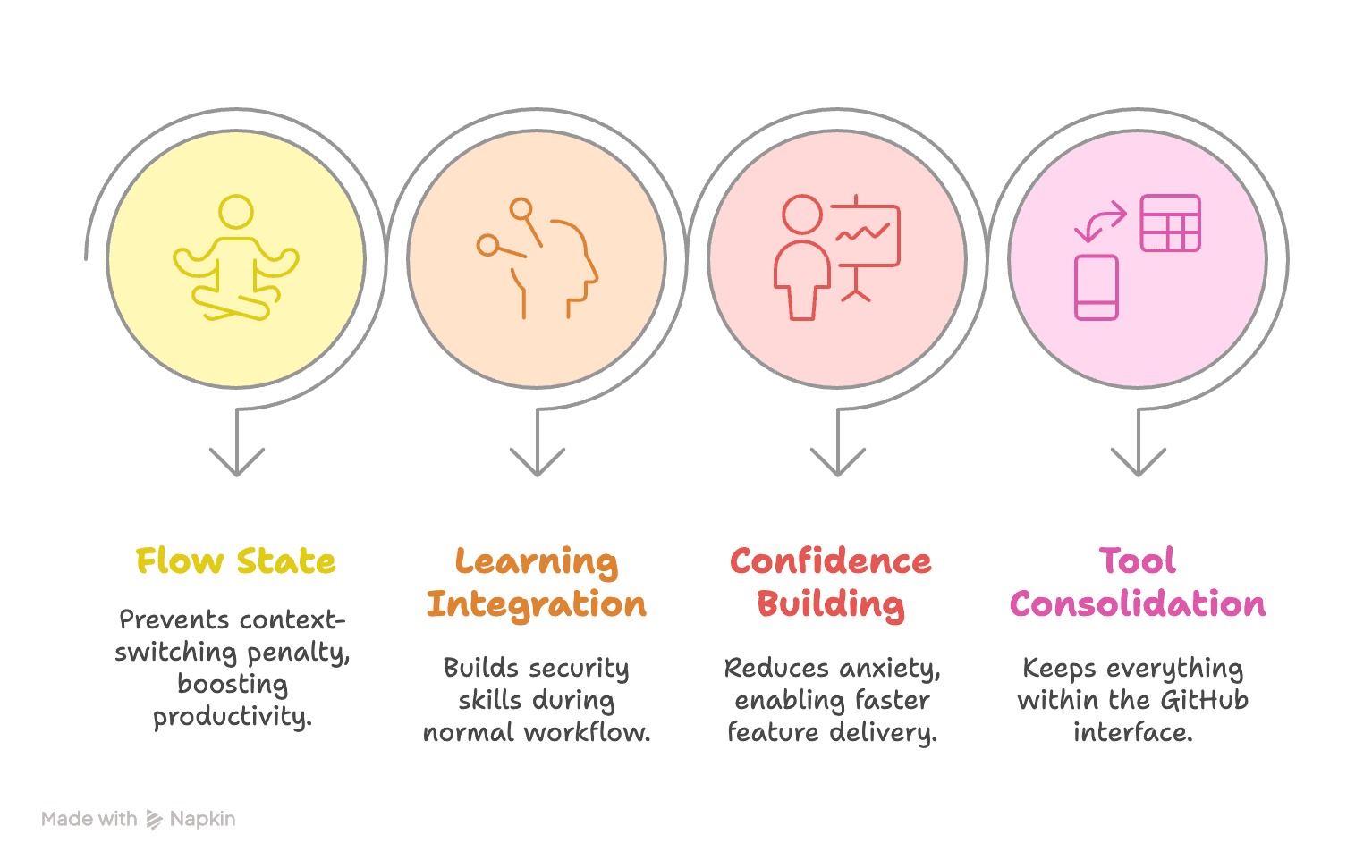
Maintain development velocity while ensuring code security: Get immediate, actionable feedback on security issues without leaving GitHub, enabling fast resolution that doesn't disrupt coding flow or delay feature delivery.
Reduce false positive fatigue and alert noise: Receive intelligent, context-aware security alerts that distinguish real threats from test data, eliminating time wasted investigating non-actionable findings.
Build security knowledge through passive learning: Develop better security practices organically through contextual guidance and educational tooltips during normal development work, without requiring separate training sessions.
Maintain development velocity while ensuring code security: Get immediate, actionable feedback on security issues without leaving GitHub, enabling fast resolution that doesn't disrupt coding flow or delay feature delivery.
Reduce false positive fatigue and alert noise: Receive intelligent, context-aware security alerts that distinguish real threats from test data, eliminating time wasted investigating non-actionable findings.
Build security knowledge through passive learning: Develop better security practices organically through contextual guidance and educational tooltips during normal development work, without requiring separate training sessions.
Captured perspectives across different team sizes, technical sophistication levels, and industry verticals. The research methodology combined behavioural observation through screen-sharing sessions with in-depth need-finding interviews, providing both quantitative workflow data and qualitative insights into user motivations and frustrations.
The research revealed critical insights about developer psychology around security tools, including what I identified as "security fatigue", a learned helplessness that emerged from repeatedly encountering false positive alerts. I documented the specific friction points that led to tool abandonment, discovering that developers would actively work around security measures that added more than 15 seconds to their pull request workflow. This primary research became the foundation for understanding not just what features users needed, but how they needed to be delivered to ensure actual adoption and sustained usage.
Captured perspectives across different team sizes, technical sophistication levels, and industry verticals. The research methodology combined behavioural observation through screen-sharing sessions with in-depth need-finding interviews, providing both quantitative workflow data and qualitative insights into user motivations and frustrations.
The research revealed critical insights about developer psychology around security tools, including what I identified as "security fatigue", a learned helplessness that emerged from repeatedly encountering false positive alerts. I documented the specific friction points that led to tool abandonment, discovering that developers would actively work around security measures that added more than 15 seconds to their pull request workflow. This primary research became the foundation for understanding not just what features users needed, but how they needed to be delivered to ensure actual adoption and sustained usage.
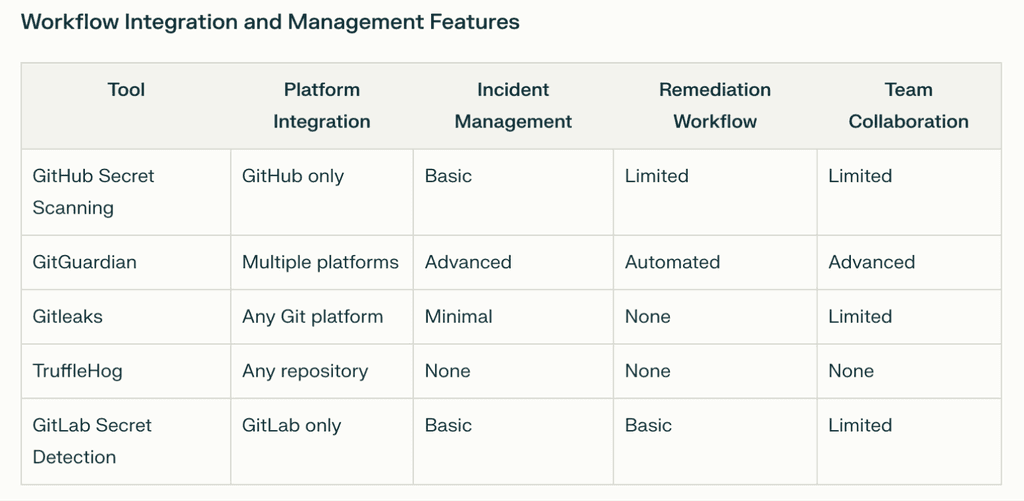
Real-Time Developer Experience Gap: While Push protection, our built-in solution, is the simplest way to block secrets from accidental exposure exists, most tools still operate as post-commit checkers rather than providing seamless, contextual feedback during the development process.
False Positive Burden: Existing tools generate significant alert fatigue, with developers spending excessive time investigating non-actionable findings, leading to tool abandonment.
Workflow Integration Deficit: Even GitHub's native tools require context switching to resolve issues, breaking developer flow and reducing adoption rates.
Real-Time Developer Experience Gap: While Push protection, our built-in solution, is the simplest way to block secrets from accidental exposure exists, most tools still operate as post-commit checkers rather than providing seamless, contextual feedback during the development process.
False Positive Burden: Existing tools generate significant alert fatigue, with developers spending excessive time investigating non-actionable findings, leading to tool abandonment.
Workflow Integration Deficit: Even GitHub's native tools require context switching to resolve issues, breaking developer flow and reducing adoption rates.
Github plugin Installation
Github plugin Installation
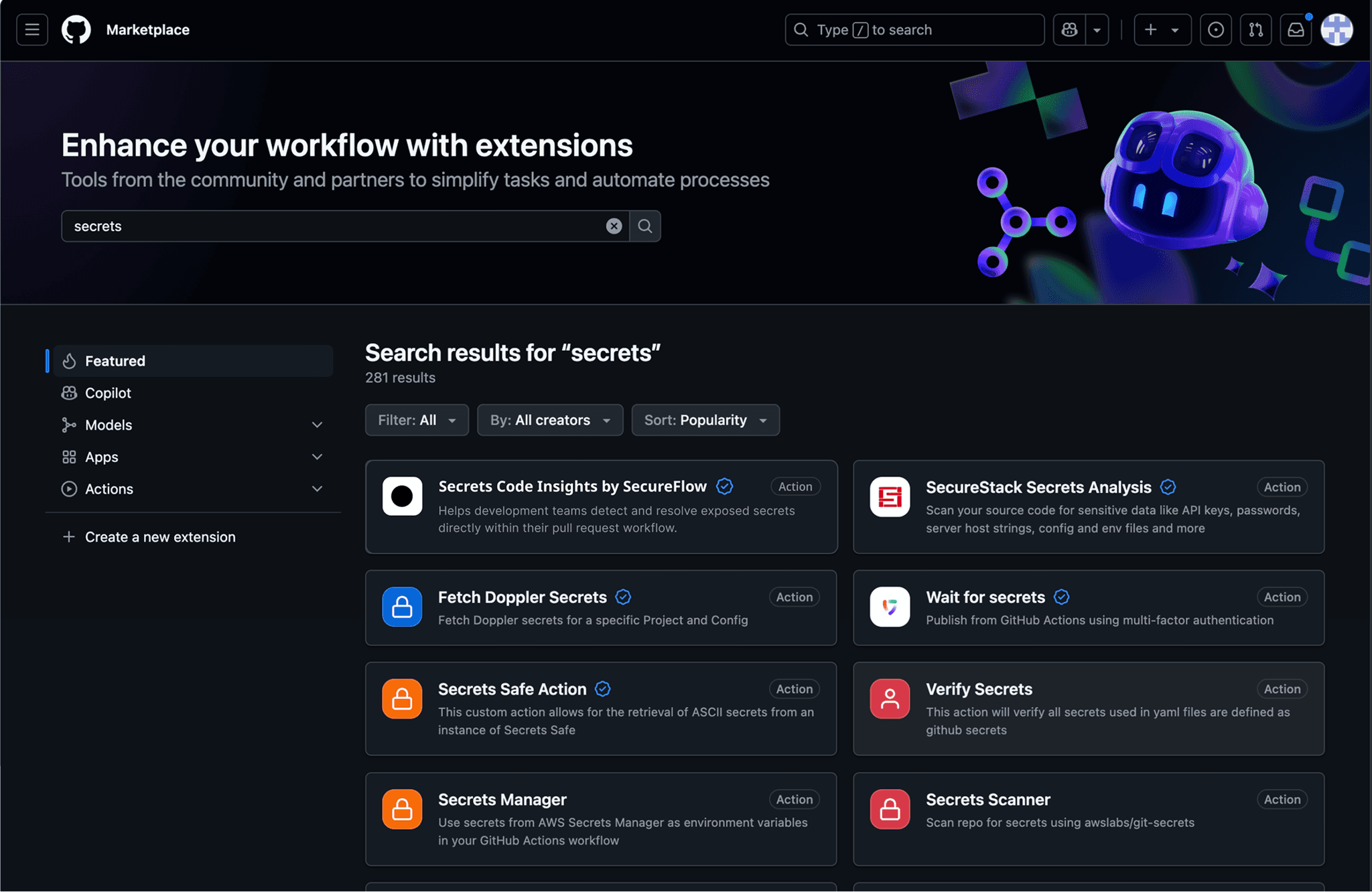
When users search for "secrets" in the GitHub Marketplace, they encounter multiple options including the Secrets Code Insights by SecureFlow plugin. This particular solution stands out because it addresses the core friction point identified in user research: 68% of developers abandon security tools due to context-switching penalties. The plugin's positioning immediately signals its value proposition of seamless GitHub integration rather than requiring external dashboards.
When users search for "secrets" in the GitHub Marketplace, they encounter multiple options including the Secrets Code Insights by SecureFlow plugin. This particular solution stands out because it addresses the core friction point identified in user research: 68% of developers abandon security tools due to context-switching penalties. The plugin's positioning immediately signals its value proposition of seamless GitHub integration rather than requiring external dashboards.
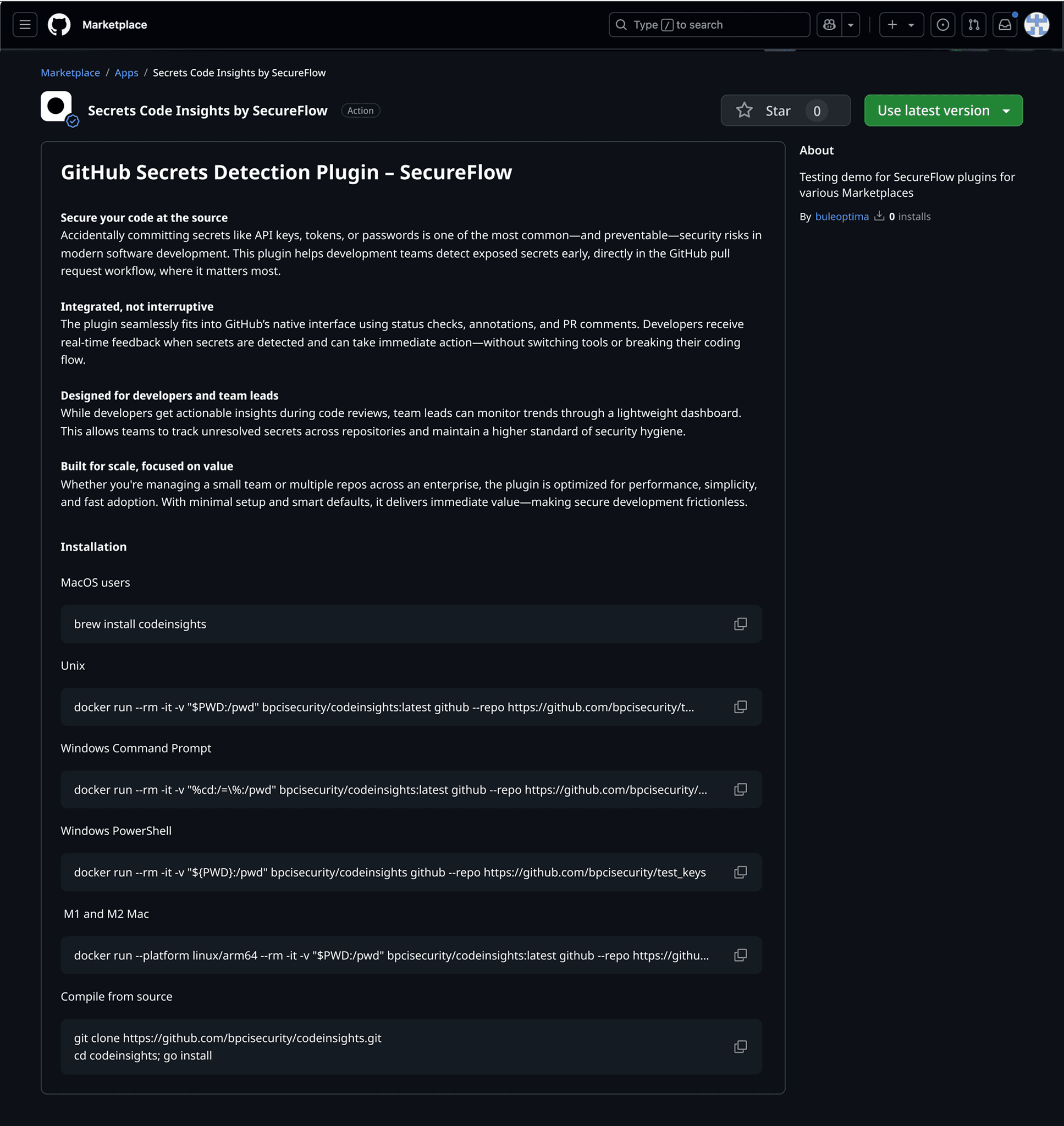
Before installation, users can see that this isn't just another scanning tool. The plugin description emphasises real-time feedback within GitHub's native interface using status checks, annotations, and PR comments. This addresses the critical insight from 27 user interviews that developers tolerate less than 15 seconds of additional PR review time and abandon tools requiring more than 4 clicks to resolve issues.
Before installation, users can see that this isn't just another scanning tool. The plugin description emphasises real-time feedback within GitHub's native interface using status checks, annotations, and PR comments. This addresses the critical insight from 27 user interviews that developers tolerate less than 15 seconds of additional PR review time and abandon tools requiring more than 4 clicks to resolve issues.
PR Check Flow Action - Solution 1
PR Check Flow Action - Solution 1
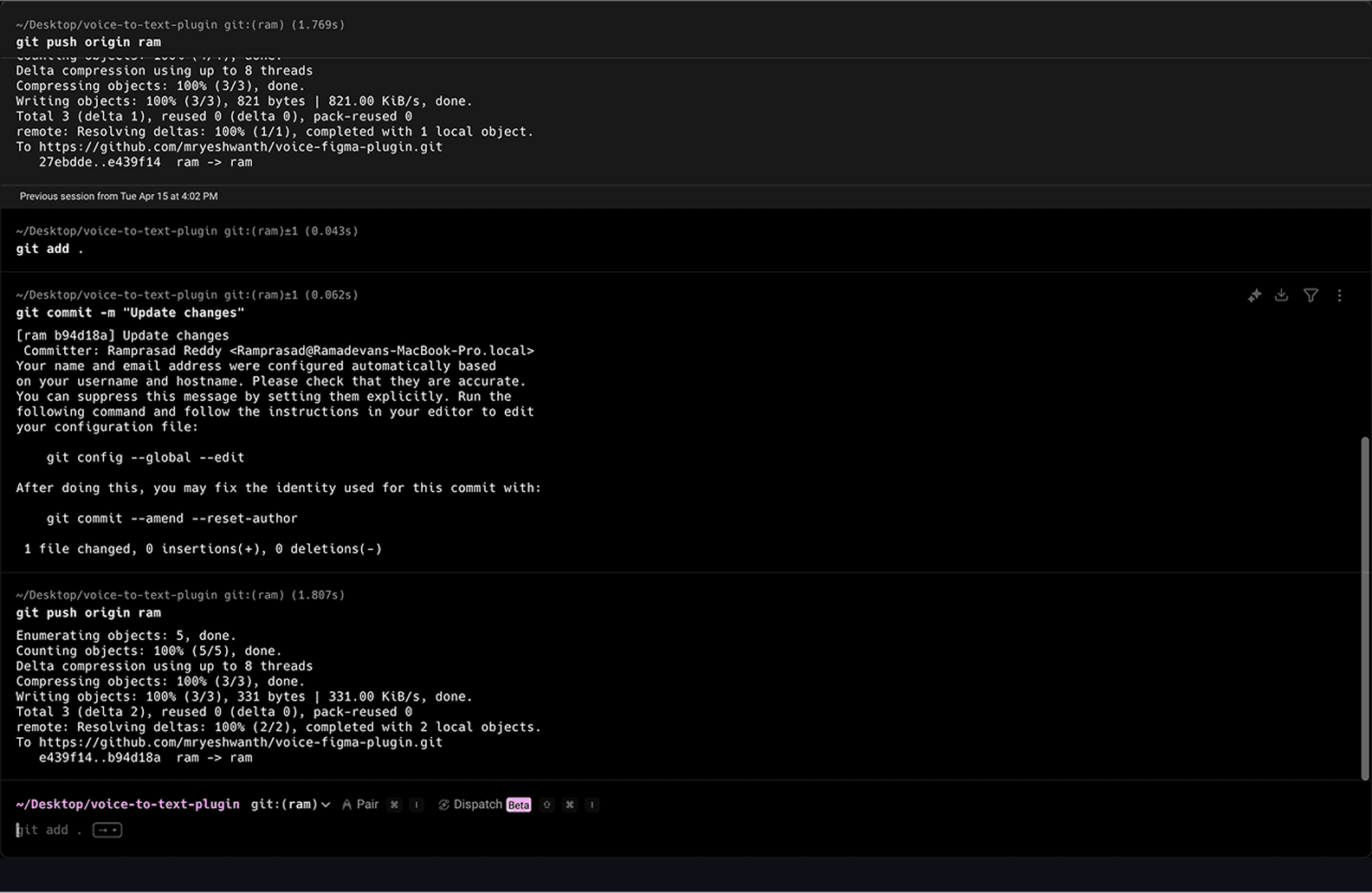
The plugin's core value proposition of transforming security from an interruption into a natural extension of the development process. When a developer commits code containing potential secrets, as shown in the terminal sequence where changes are pushed to the testing-secrets repository, the plugin immediately integrates into GitHub's native PR interface without requiring any external tools or context switching.
The system runs automated secret detection as part of the standard PR checks workflow, appearing alongside other familiar checks like build status and test results. This seamless integration addresses the critical insight from user research that developers abandon security tools requiring more than 2 clicks or 15 seconds of additional workflow time.
The plugin's core value proposition of transforming security from an interruption into a natural extension of the development process. When a developer commits code containing potential secrets, as shown in the terminal sequence where changes are pushed to the testing-secrets repository, the plugin immediately integrates into GitHub's native PR interface without requiring any external tools or context switching.
The system runs automated secret detection as part of the standard PR checks workflow, appearing alongside other familiar checks like build status and test results. This seamless integration addresses the critical insight from user research that developers abandon security tools requiring more than 2 clicks or 15 seconds of additional workflow time.
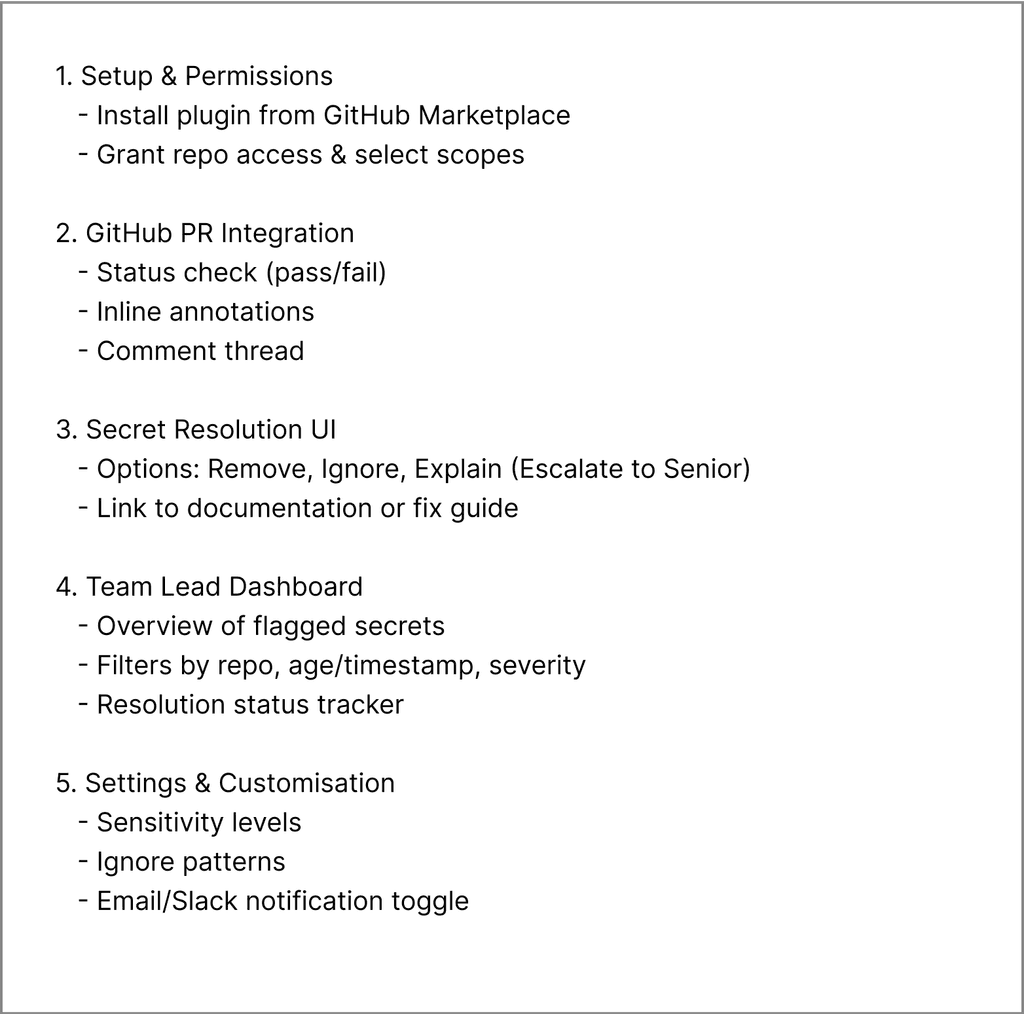
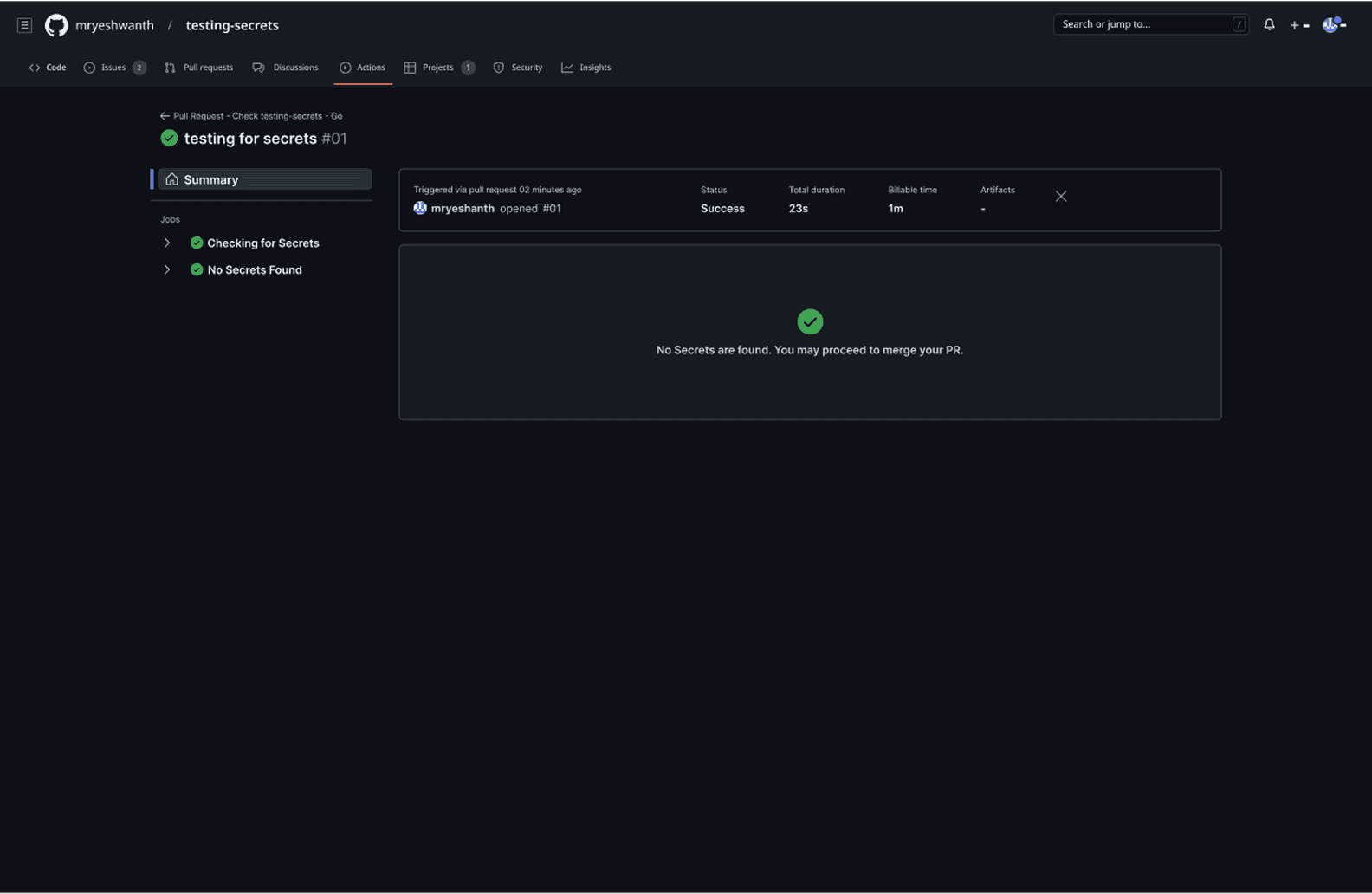
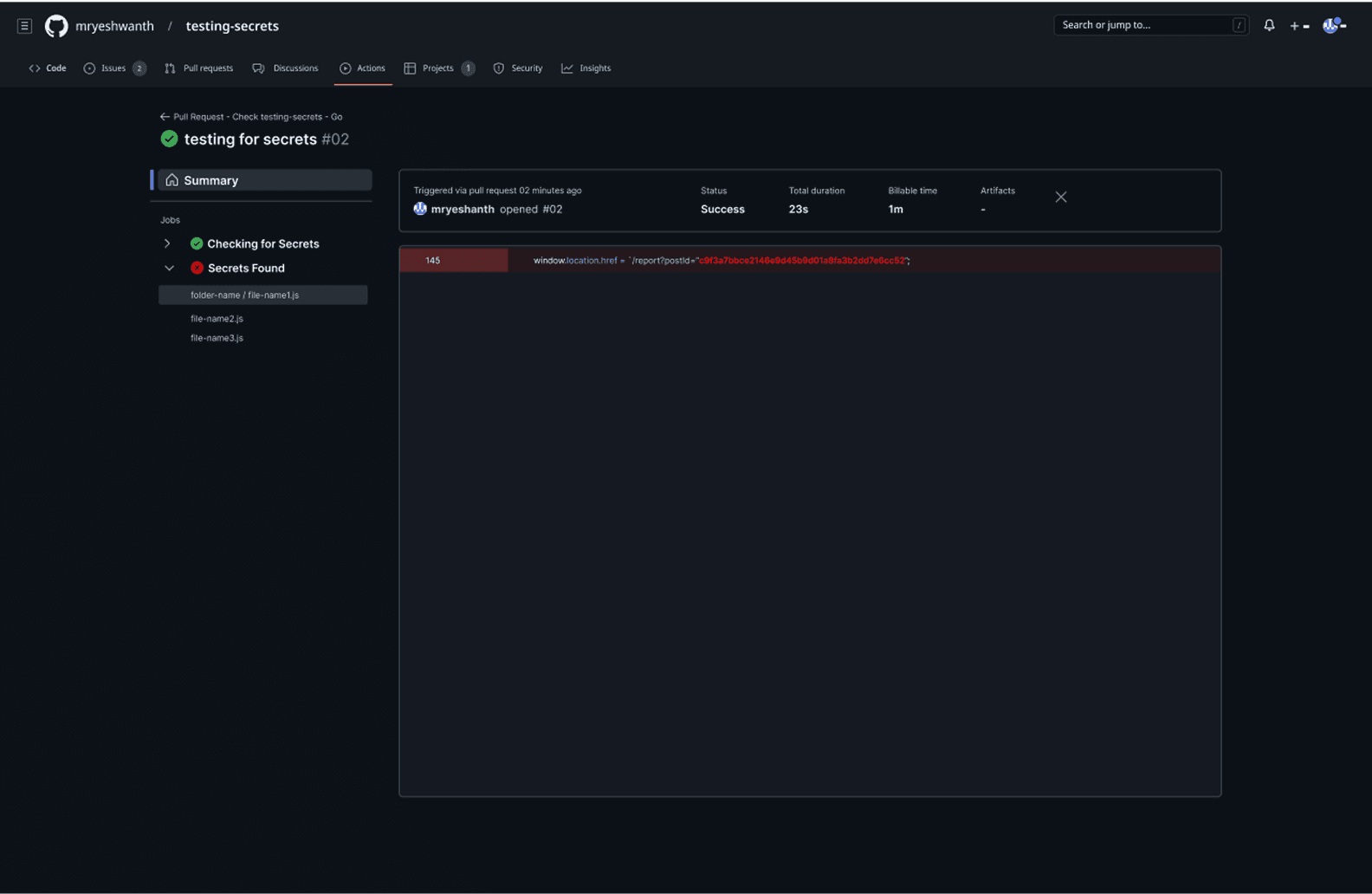
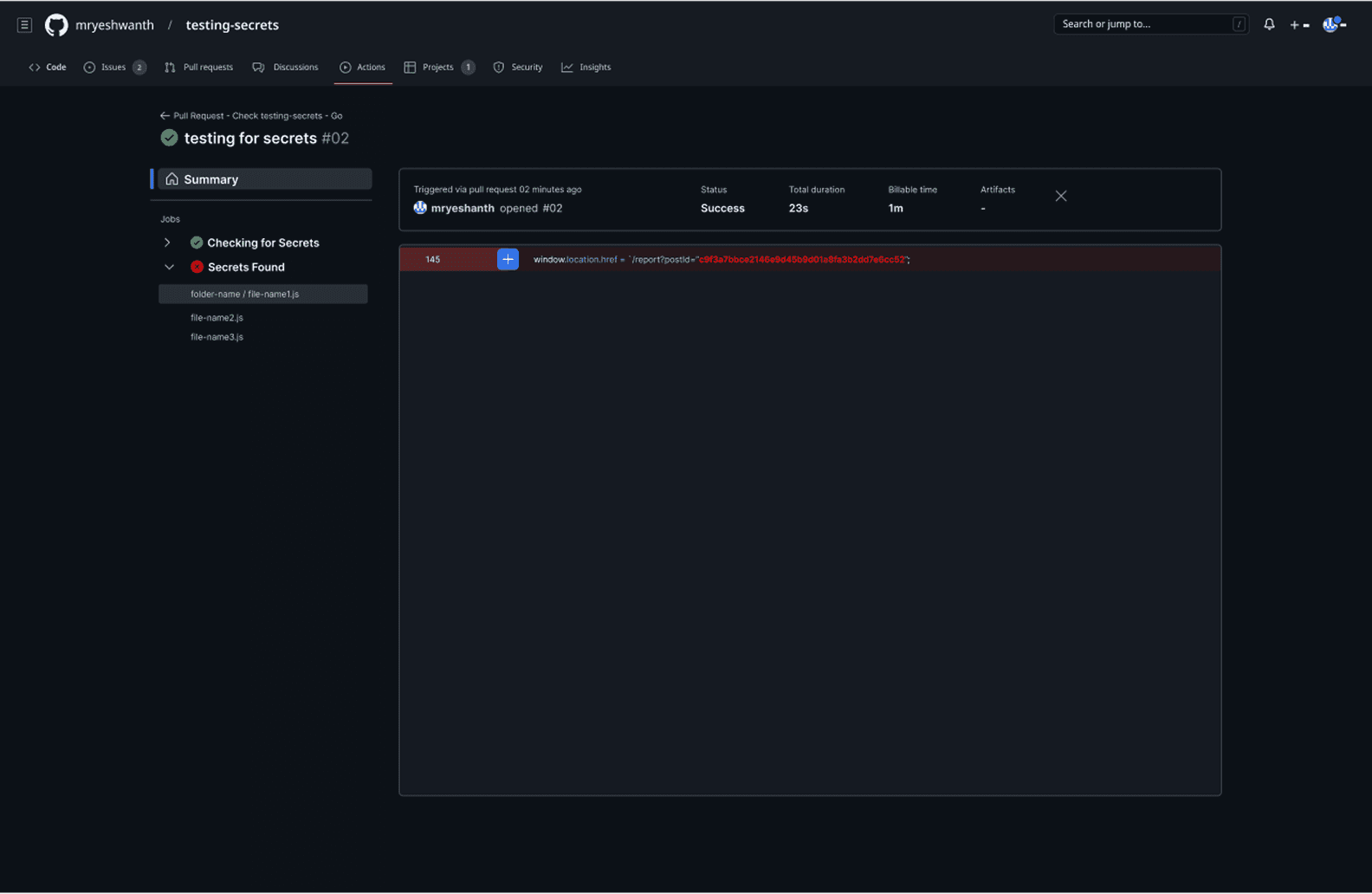
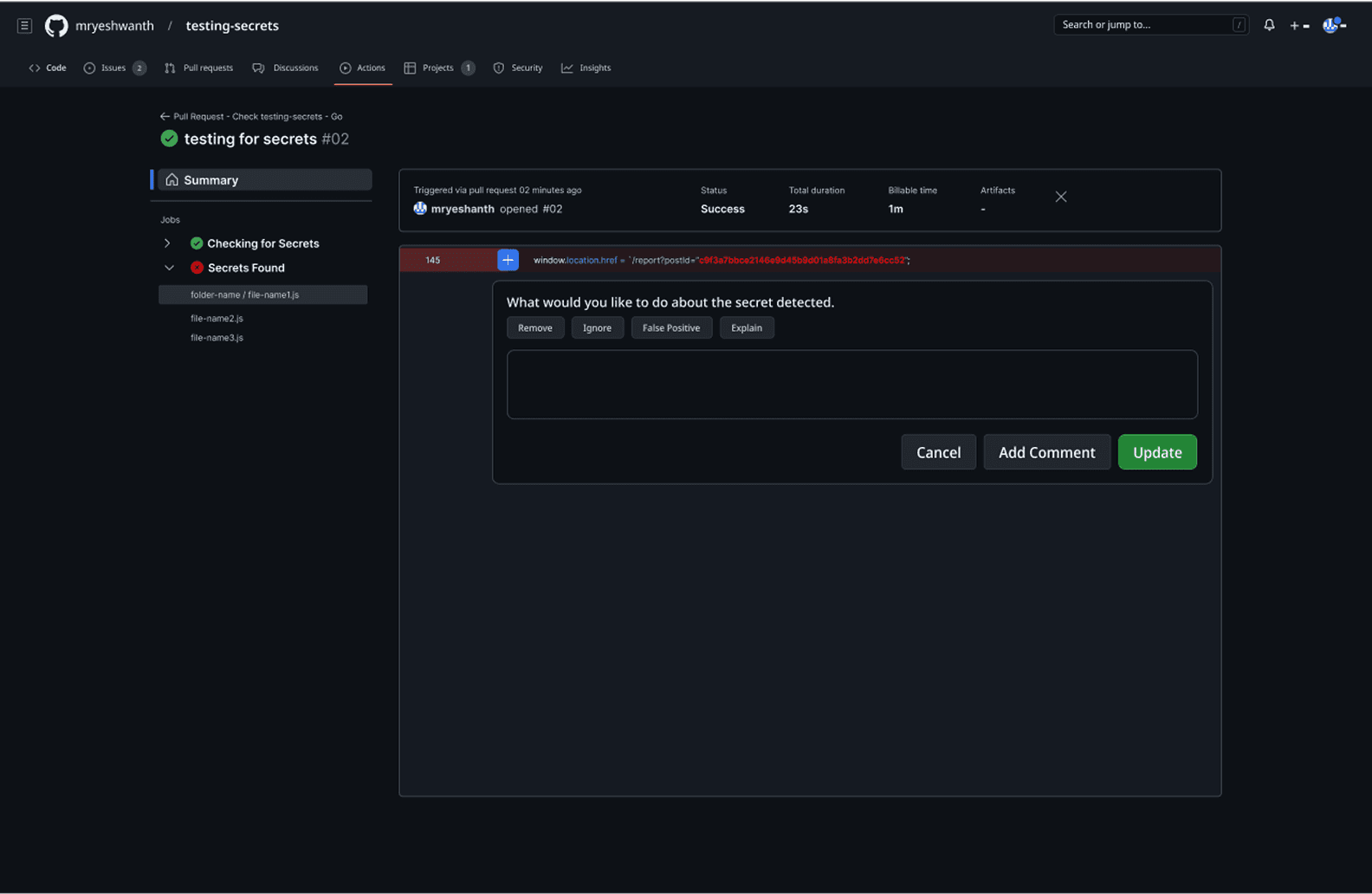
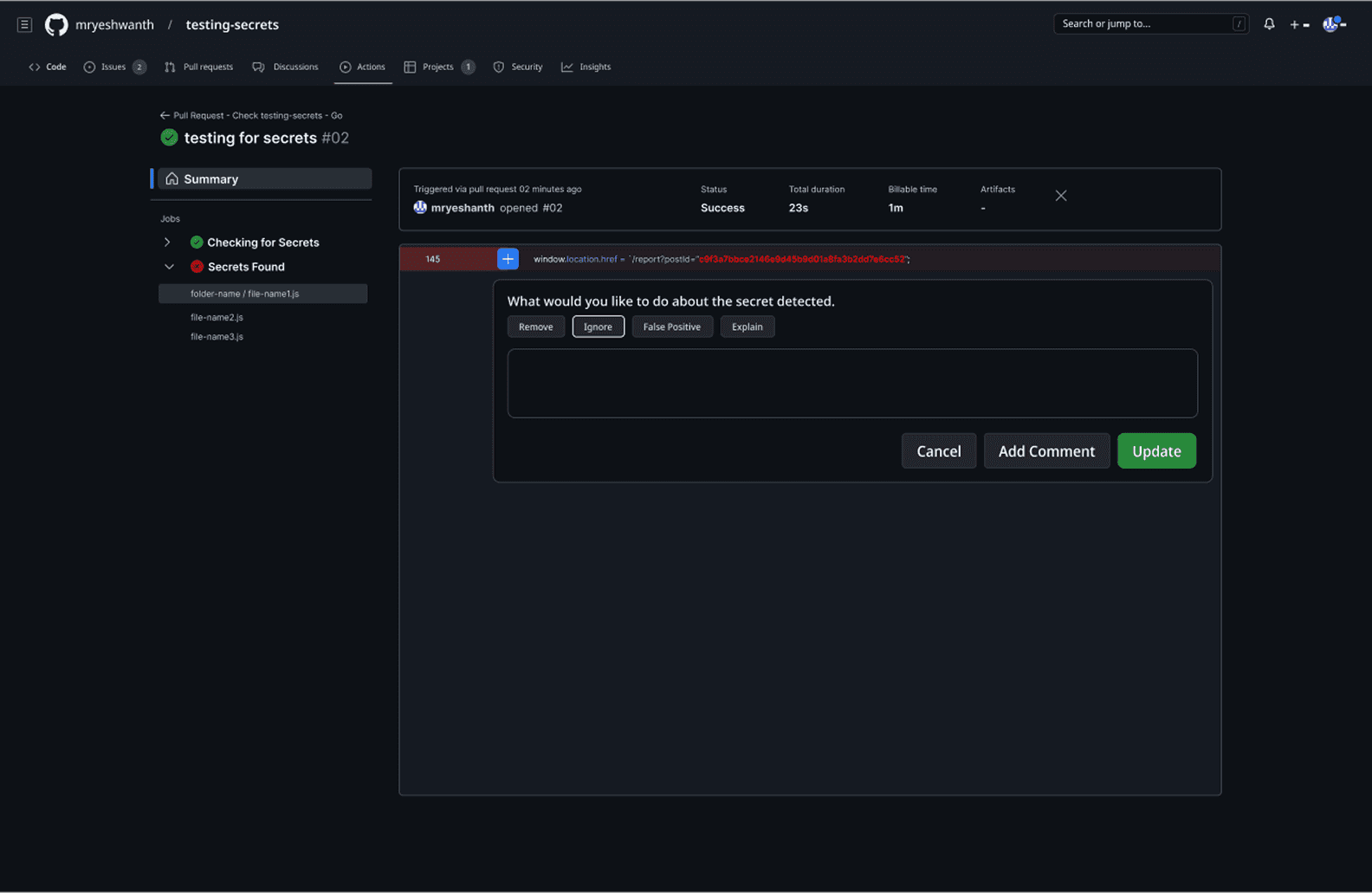
The plugin's intelligence becomes evident in its differentiated response patterns based on the security risk level of detected secrets. In the clean scenario (PR #01), when no secrets are detected, the system displays a clear green checkmark with "No Secrets are found. You may proceed to merge your PR," allowing the development process to continue unimpeded. However, when secrets are identified, the plugin transforms into an actionable decision interface, highlighting the problematic code in red and presenting contextual options: Remove, Ignore, False Positive, or Explain.
This approach directly addresses the 23% false positive rate that traditionally frustrates developers by providing immediate resolution paths within the same interface. The expandable file structure on the left shows exactly which files contain issues, while the inline annotation system ensures developers can address problems without losing context of their code changes, embodying the 1.8-minute resolution time that became the design benchmark for maintaining developer velocity while ensuring security compliance.
The plugin's intelligence becomes evident in its differentiated response patterns based on the security risk level of detected secrets. In the clean scenario (PR #01), when no secrets are detected, the system displays a clear green checkmark with "No Secrets are found. You may proceed to merge your PR," allowing the development process to continue unimpeded. However, when secrets are identified, the plugin transforms into an actionable decision interface, highlighting the problematic code in red and presenting contextual options: Remove, Ignore, False Positive, or Explain.
This approach directly addresses the 23% false positive rate that traditionally frustrates developers by providing immediate resolution paths within the same interface. The expandable file structure on the left shows exactly which files contain issues, while the inline annotation system ensures developers can address problems without losing context of their code changes, embodying the 1.8-minute resolution time that became the design benchmark for maintaining developer velocity while ensuring security compliance.
PR Check Flow Action - Solution 2
PR Check Flow Action - Solution 2
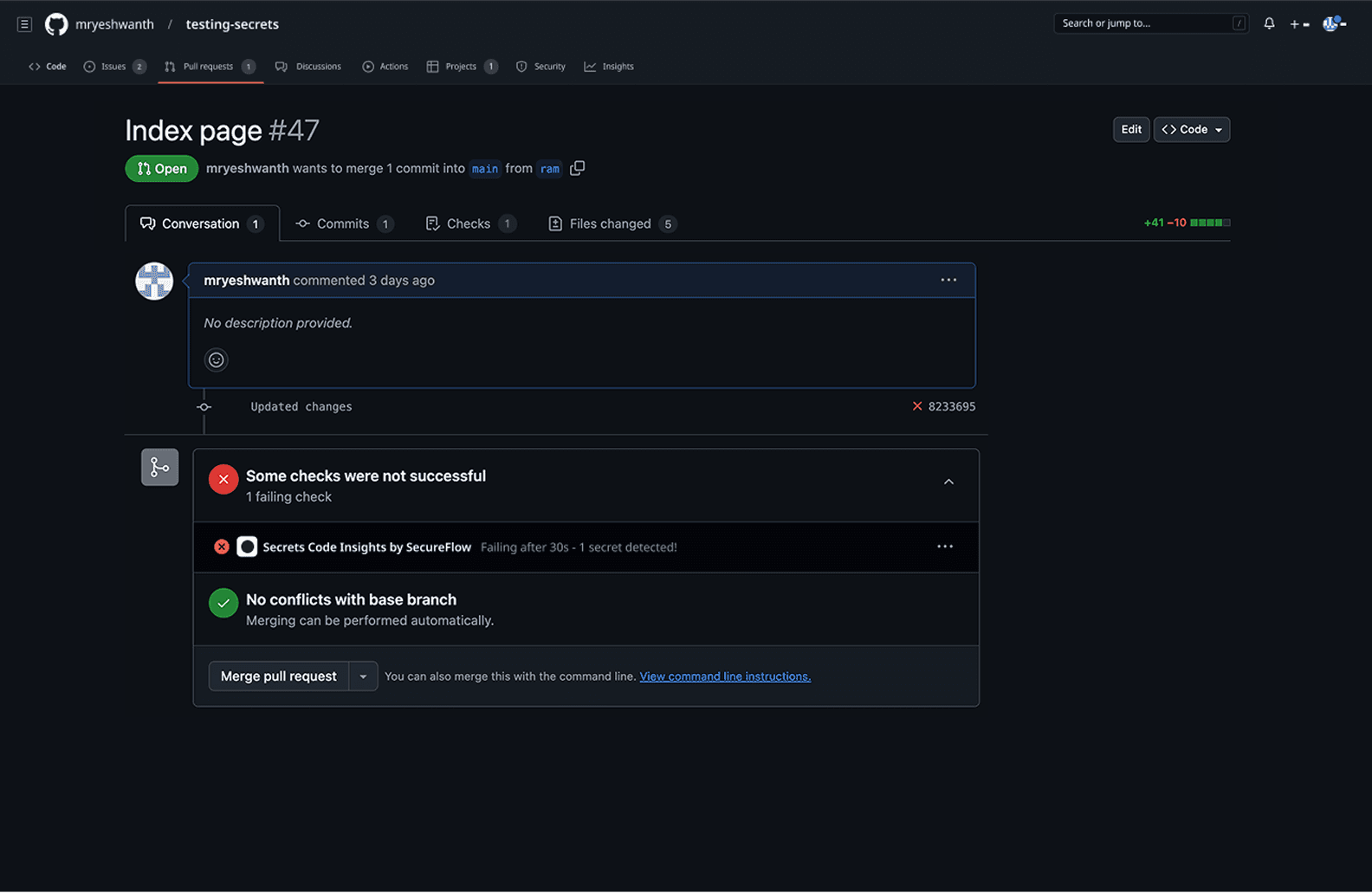
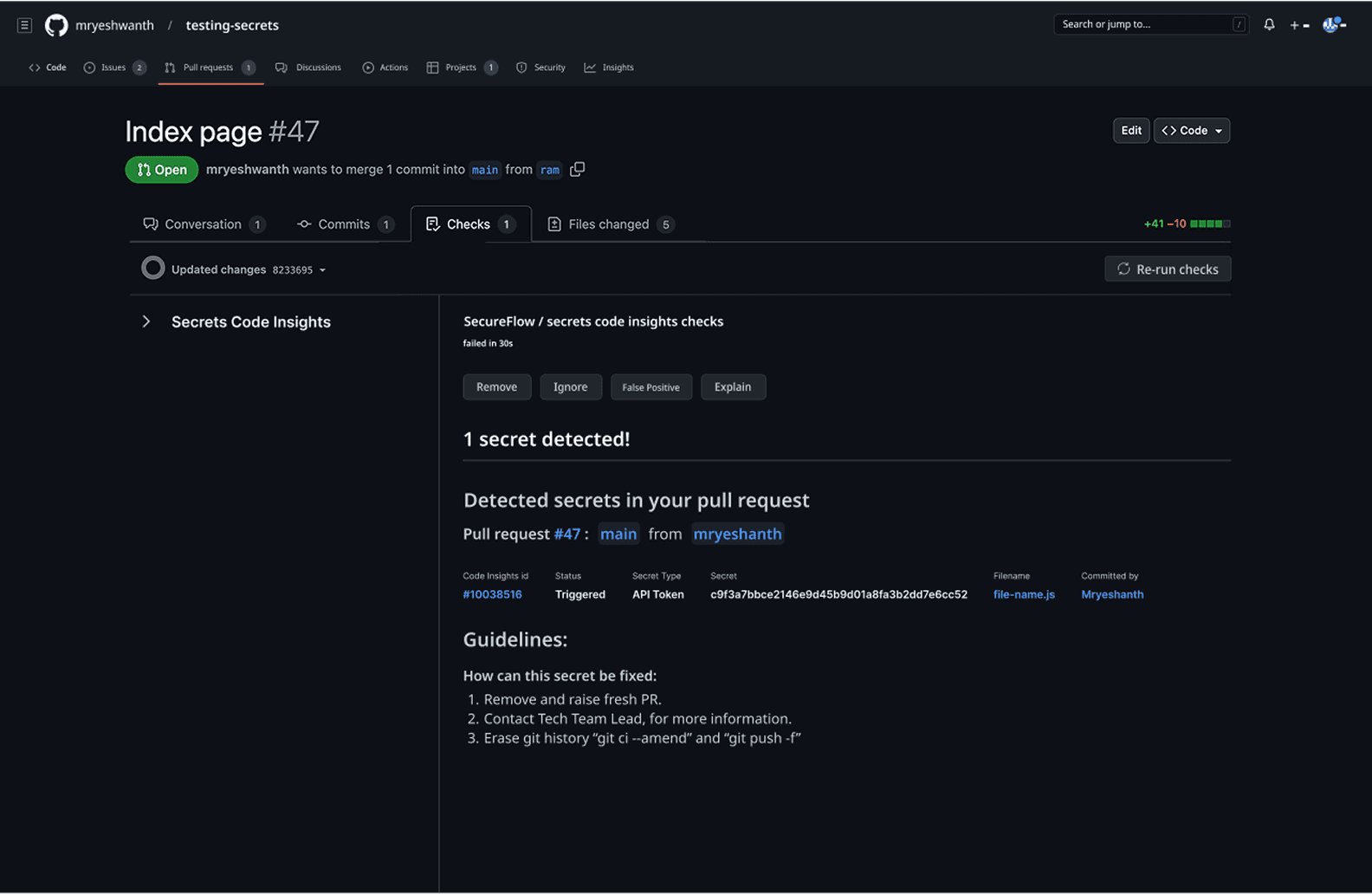
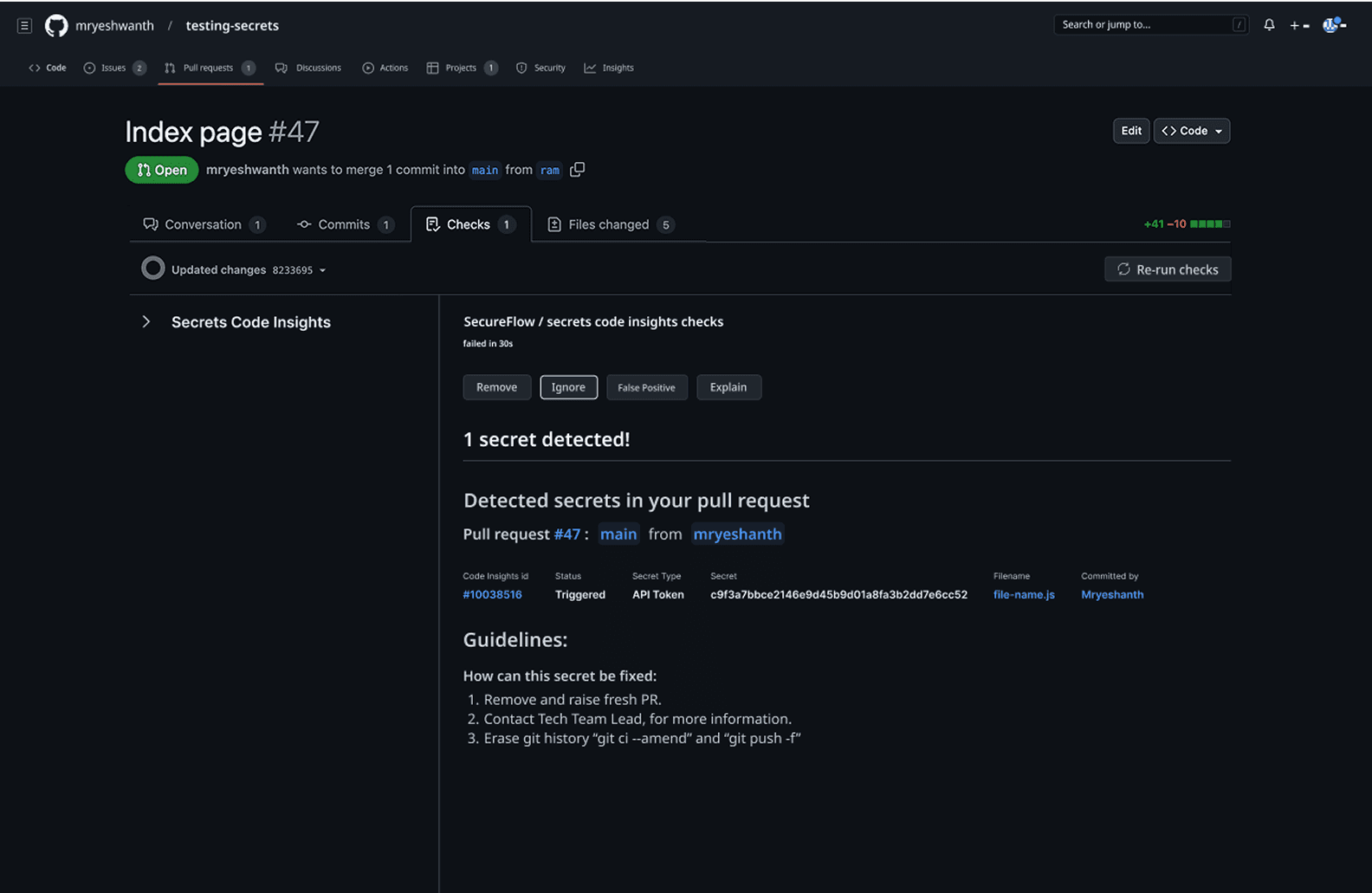
When a developer creates or updates a PR, the system automatically scans the code changes and presents findings directly within GitHub's familiar interface, where "Secrets Code Insights by SecureFlow" appears alongside other PR checks with a clear secret detected status. The solution priorities developer experience by providing immediate contextual actions (Remove, Ignore, False Positive, Explain) without requiring navigation to external dashboards, while the detailed view shows precisely what was detected along with actionable remediation guidelines.
This approach maintains the sub-2-minute resolution time benchmark by keeping developers within their existing workflow, while the check status integration ensures that high-risk secrets can block merges automatically, transforming security from a post-merge cleanup task into a seamless quality gate that feels native to GitHub's development experience.
When a developer creates or updates a PR, the system automatically scans the code changes and presents findings directly within GitHub's familiar interface, where "Secrets Code Insights by SecureFlow" appears alongside other PR checks with a clear secret detected status. The solution priorities developer experience by providing immediate contextual actions (Remove, Ignore, False Positive, Explain) without requiring navigation to external dashboards, while the detailed view shows precisely what was detected along with actionable remediation guidelines.
This approach maintains the sub-2-minute resolution time benchmark by keeping developers within their existing workflow, while the check status integration ensures that high-risk secrets can block merges automatically, transforming security from a post-merge cleanup task into a seamless quality gate that feels native to GitHub's development experience.
PR Check Flow Action - Solution 3
PR Check Flow Action - Solution 3
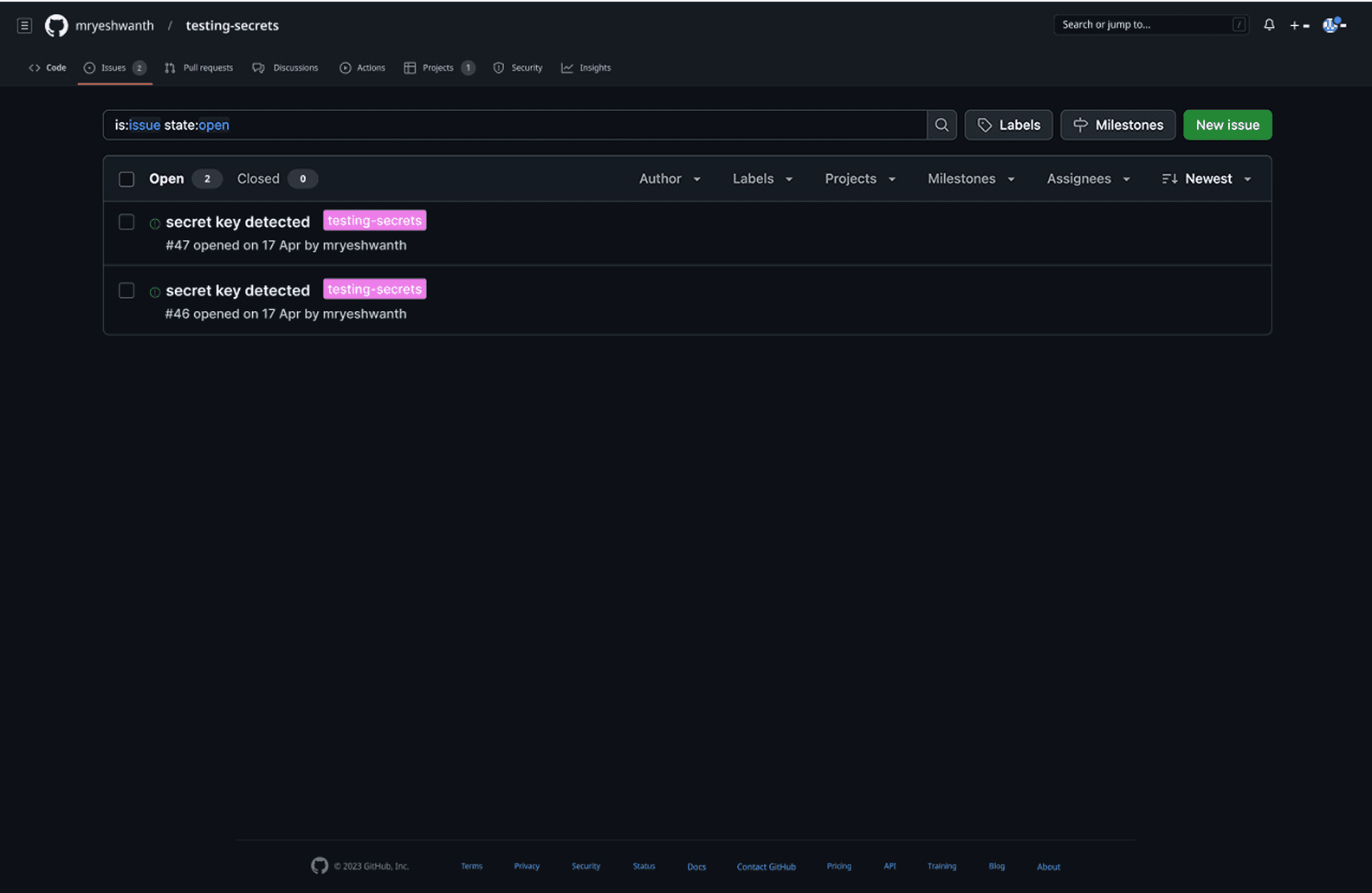
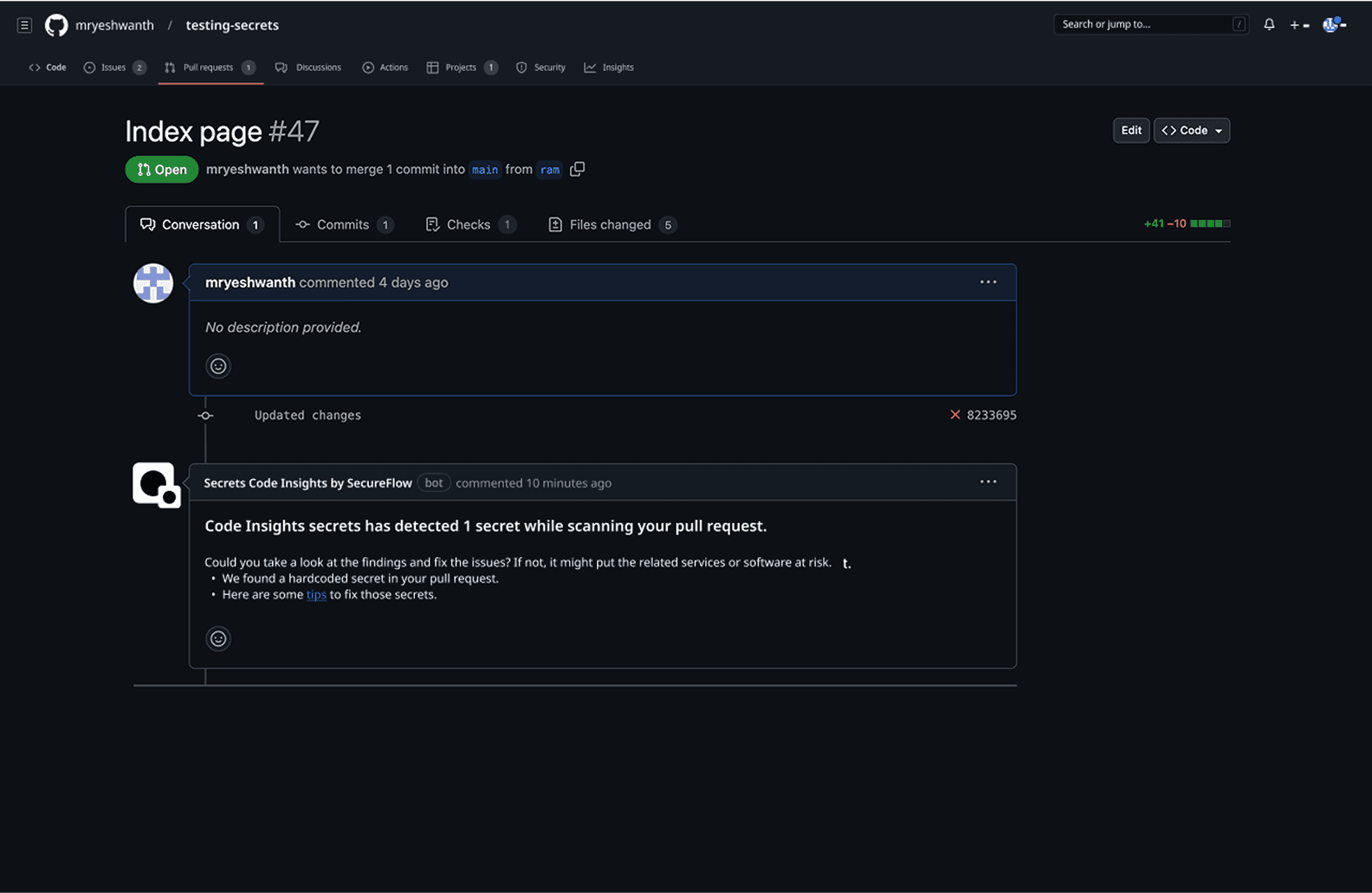
when the secret detection system finds hardcoded credentials during PR scanning, it automatically generates issues labeled that serve as persistent reminders and tracking mechanisms for security remediation. The bot integration appears directly in PR conversations, posting contextual comments like "Code Insights secrets has detected 1 secret while scanning your pull request" with specific guidance on remediation steps, including helpful links and tips for fixing the issues.
This approach ensures that security findings don't get lost in the PR review process, instead, they become part of the team's backlog and sprint planning, with clear visibility for team leads who can track resolution progress through standard GitHub issue management tools, supporting the case study's goal of providing team lead visibility while maintaining developer workflow continuity.
when the secret detection system finds hardcoded credentials during PR scanning, it automatically generates issues labeled that serve as persistent reminders and tracking mechanisms for security remediation. The bot integration appears directly in PR conversations, posting contextual comments like "Code Insights secrets has detected 1 secret while scanning your pull request" with specific guidance on remediation steps, including helpful links and tips for fixing the issues.
This approach ensures that security findings don't get lost in the PR review process, instead, they become part of the team's backlog and sprint planning, with clear visibility for team leads who can track resolution progress through standard GitHub issue management tools, supporting the case study's goal of providing team lead visibility while maintaining developer workflow continuity.
Dashboard - For Team Leads
Dashboard - For Team Leads
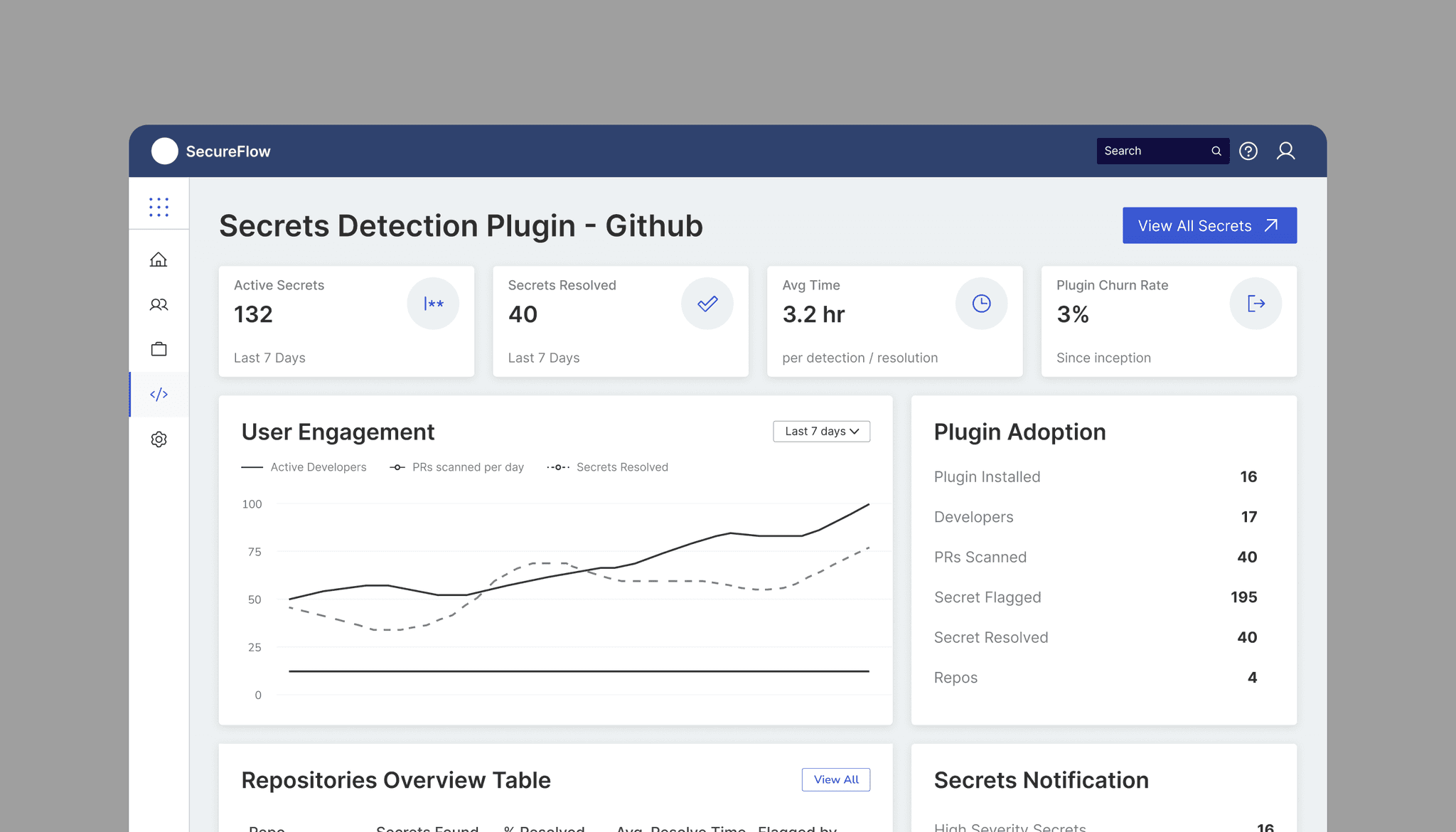
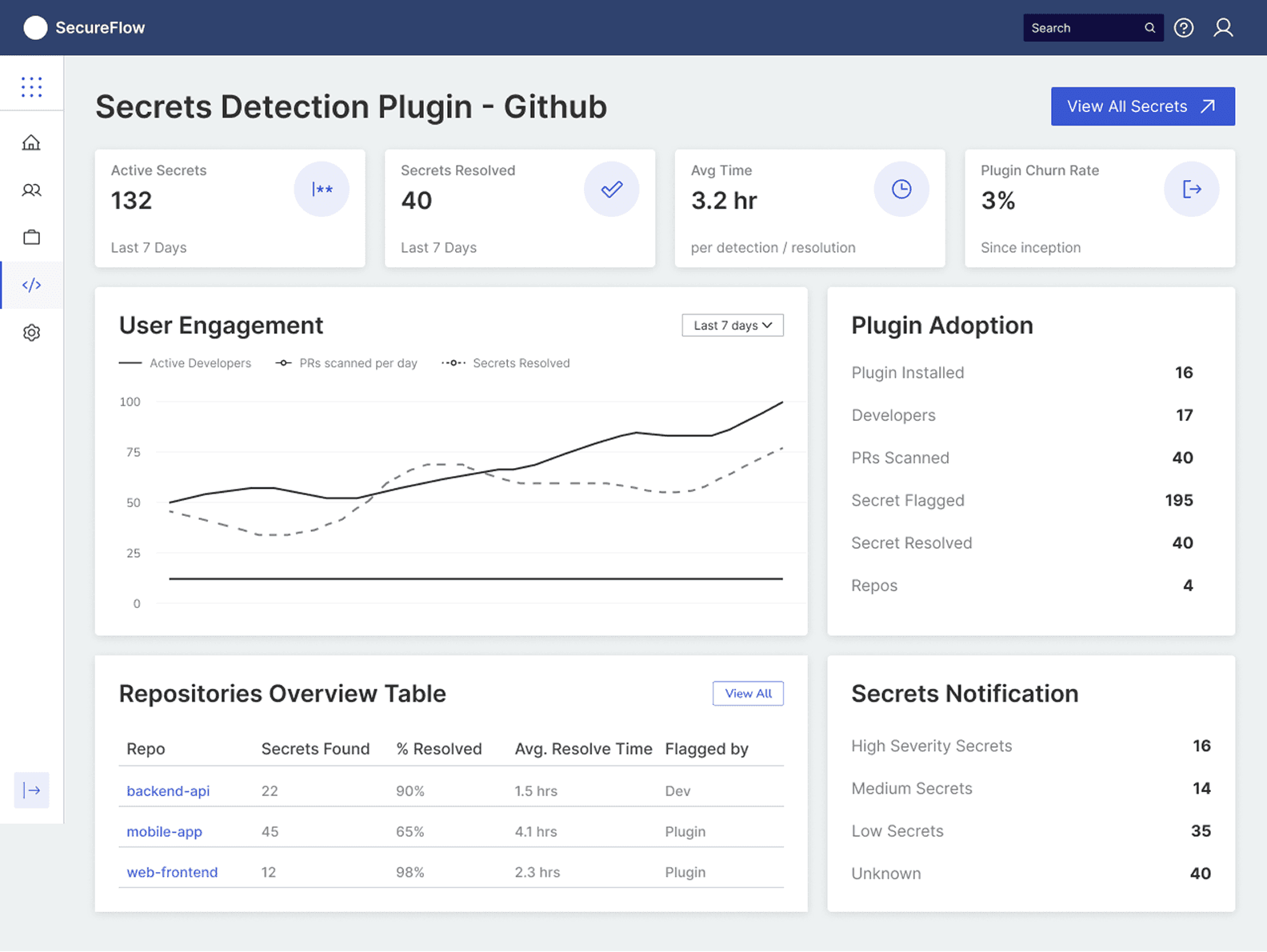
The dashboard design priorities actionable intelligence over information overload, addressing the core challenge that team leads face: balancing security oversight with team productivity. By consolidating multiple data streams into a single interface, the design eliminates the context-switching penalty that caused 68% of developers to abandon security tools.
The visual hierarchy guides attention to the most critical issues first active secrets demanding immediate action while the trend analysis enables predictive management rather than crisis response. This approach directly tackles the problem where team leads previously spent 5-7 hours weekly manually reviewing code, now condensing that oversight into focused 15-minute Monday morning reviews.
The design philosophy centres on transforming security from a compliance burden into a team performance indicator, allowing leaders to celebrate improvements in secret hygiene alongside code quality metrics, ultimately fostering a culture where security becomes a source of team pride rather than individual shame.
The dashboard design priorities actionable intelligence over information overload, addressing the core challenge that team leads face: balancing security oversight with team productivity. By consolidating multiple data streams into a single interface, the design eliminates the context-switching penalty that caused 68% of developers to abandon security tools.
The visual hierarchy guides attention to the most critical issues first active secrets demanding immediate action while the trend analysis enables predictive management rather than crisis response. This approach directly tackles the problem where team leads previously spent 5-7 hours weekly manually reviewing code, now condensing that oversight into focused 15-minute Monday morning reviews.
The design philosophy centres on transforming security from a compliance burden into a team performance indicator, allowing leaders to celebrate improvements in secret hygiene alongside code quality metrics, ultimately fostering a culture where security becomes a source of team pride rather than individual shame.
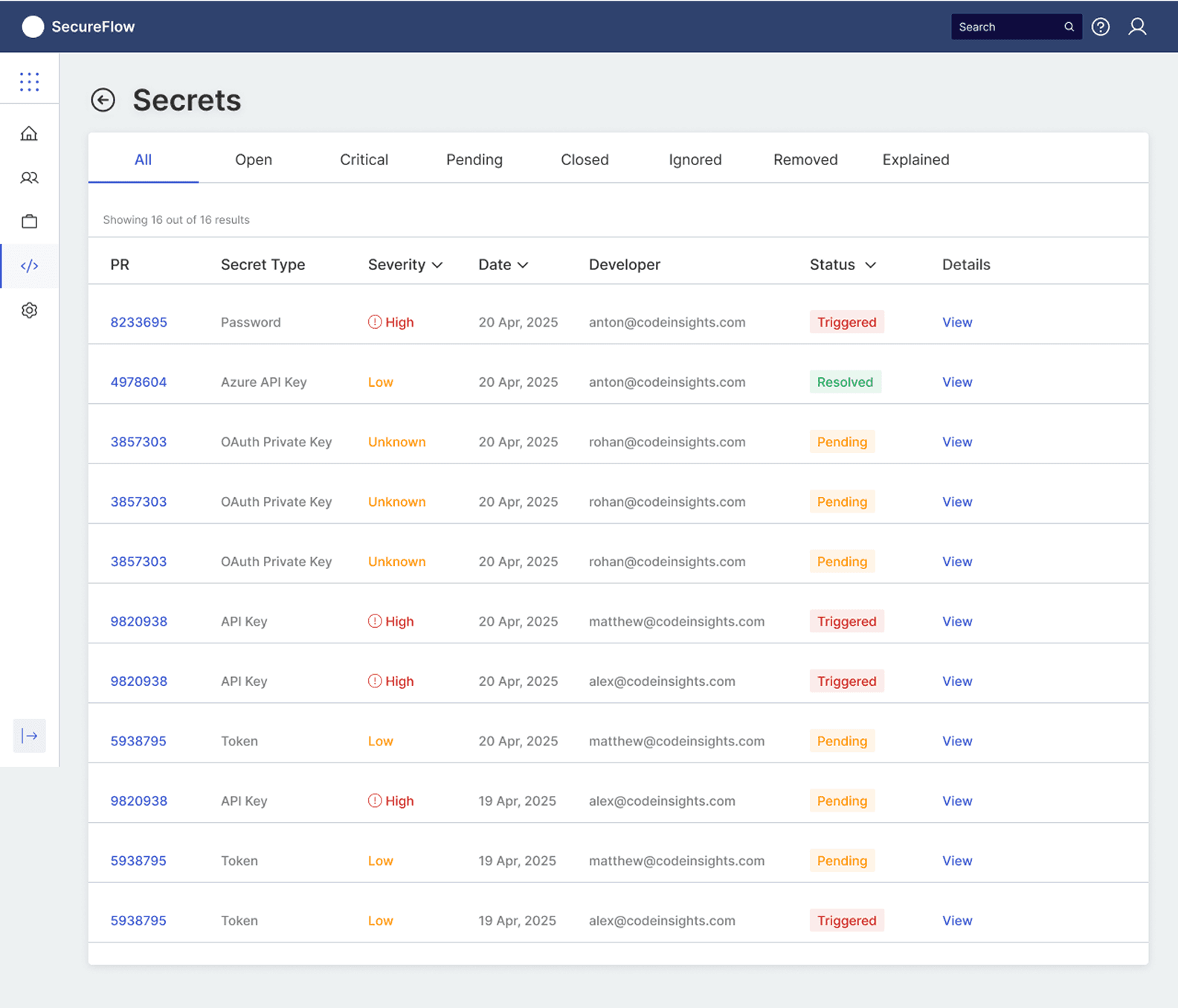
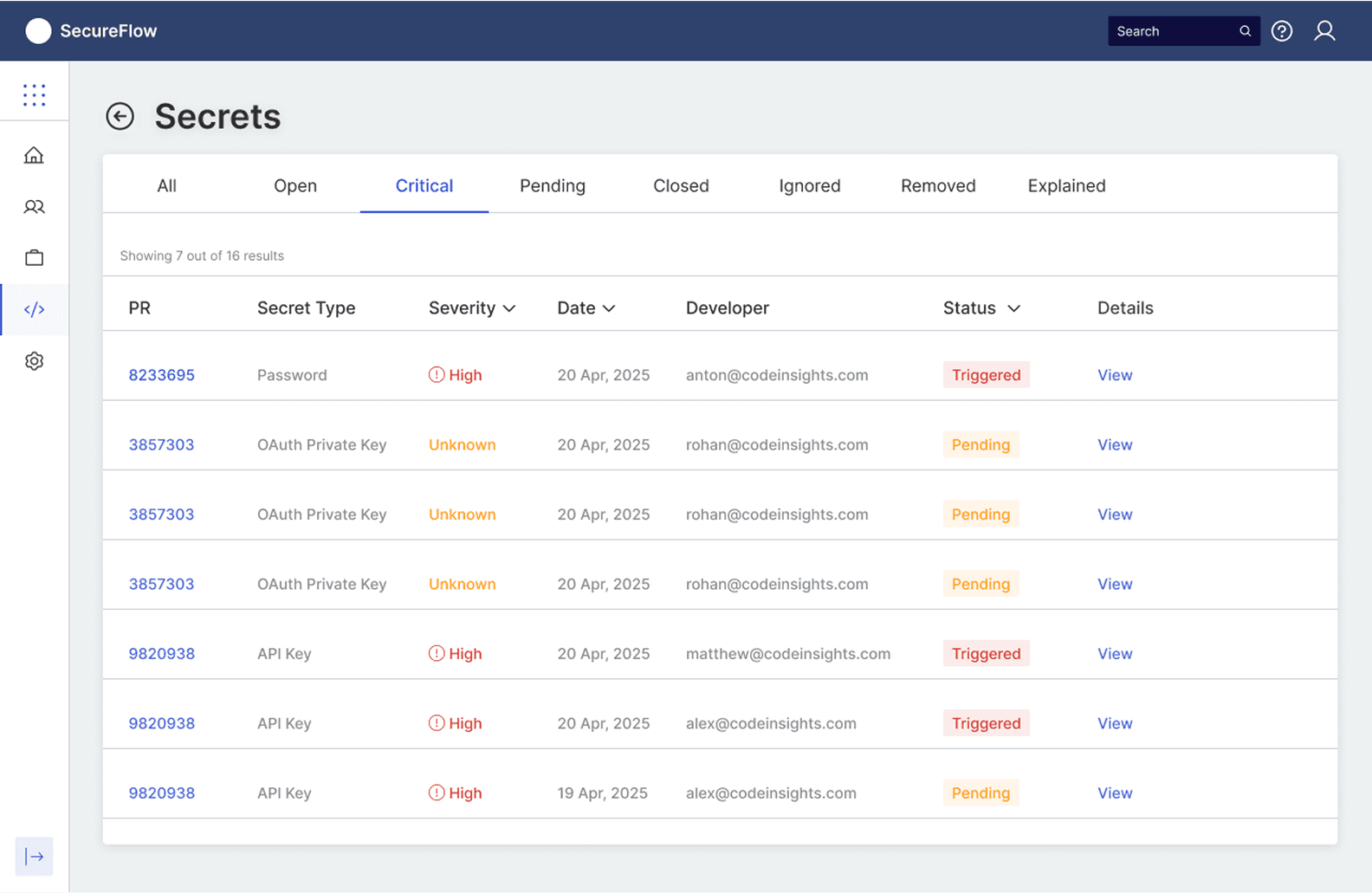
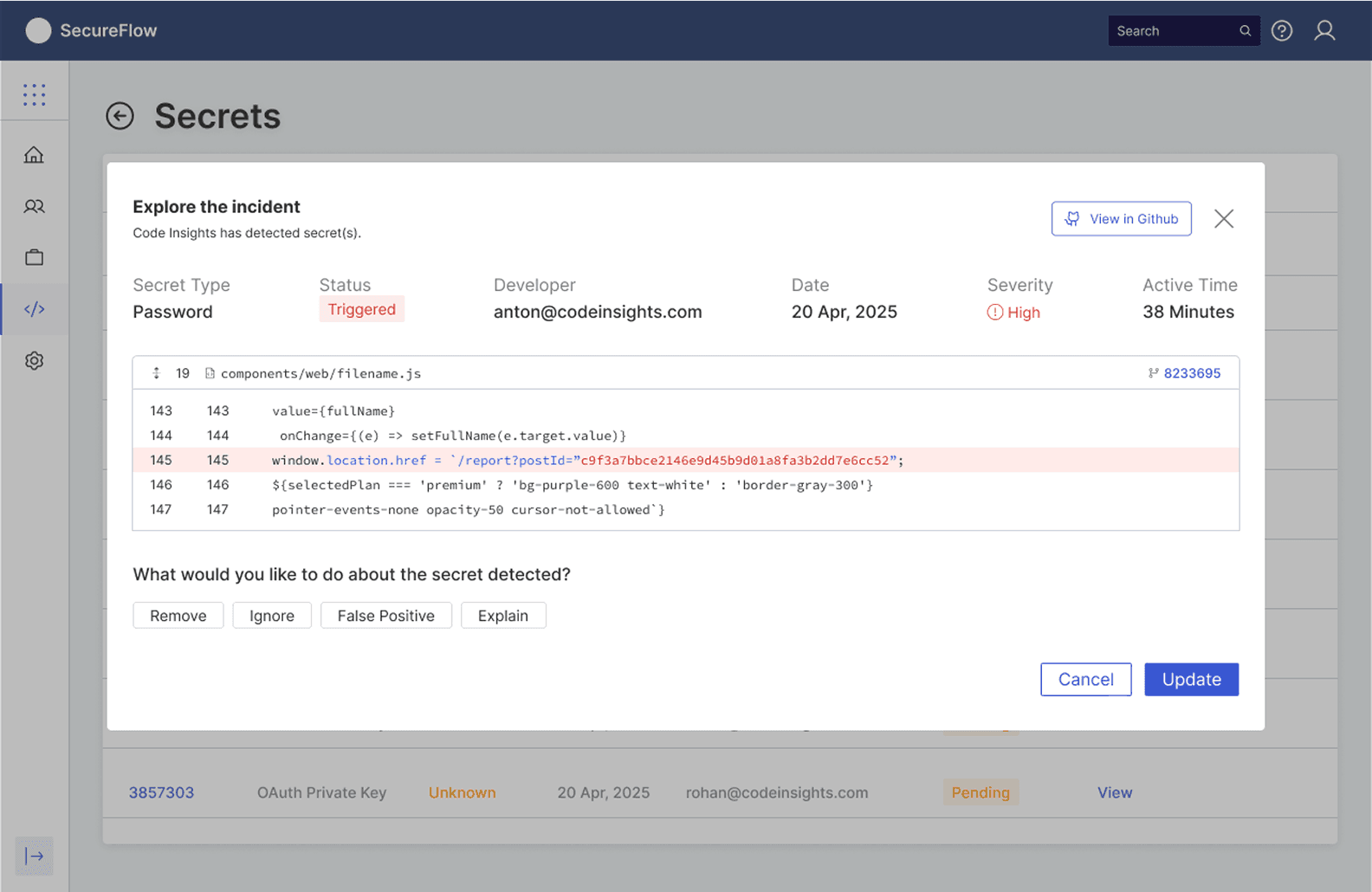
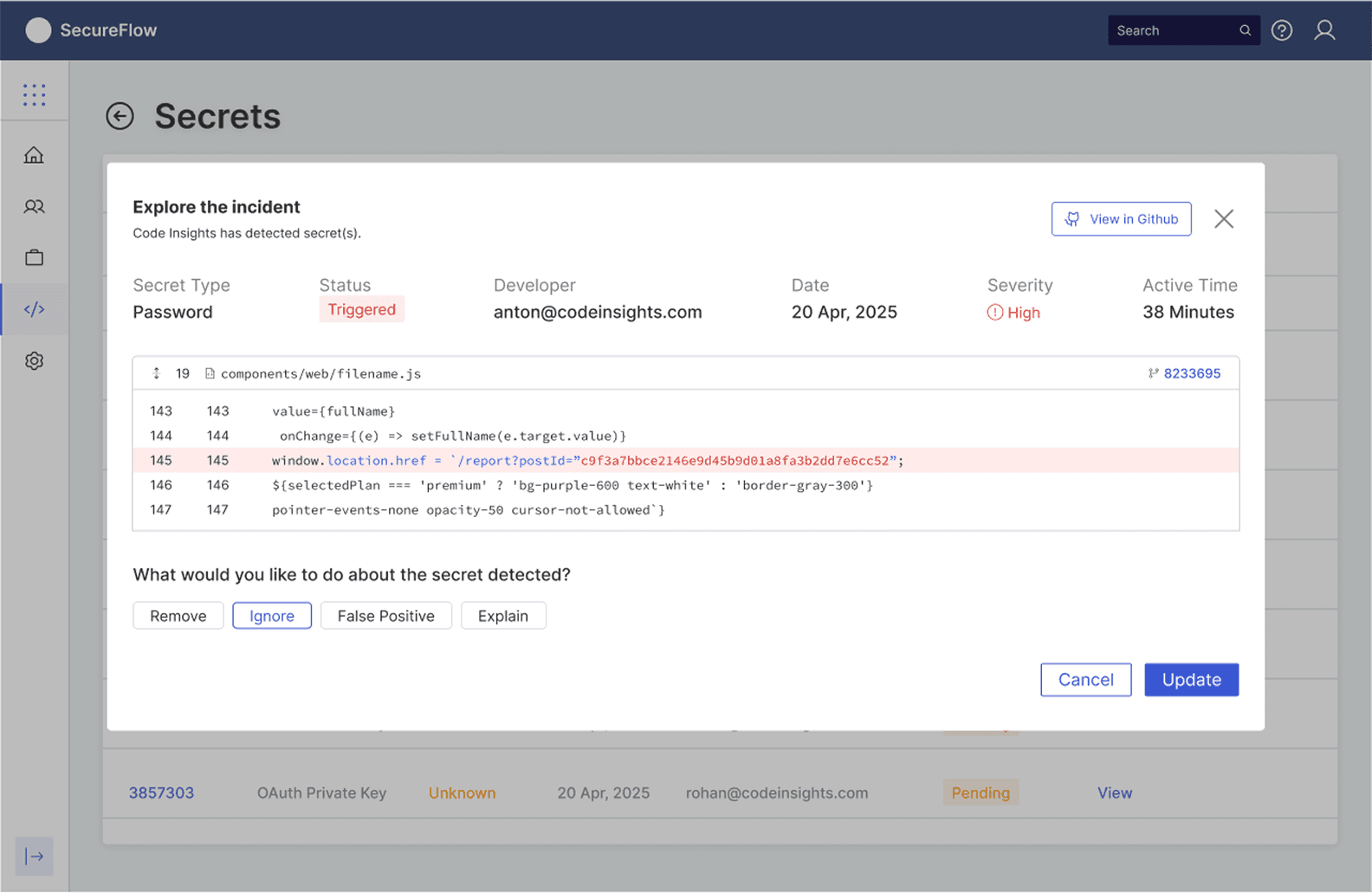
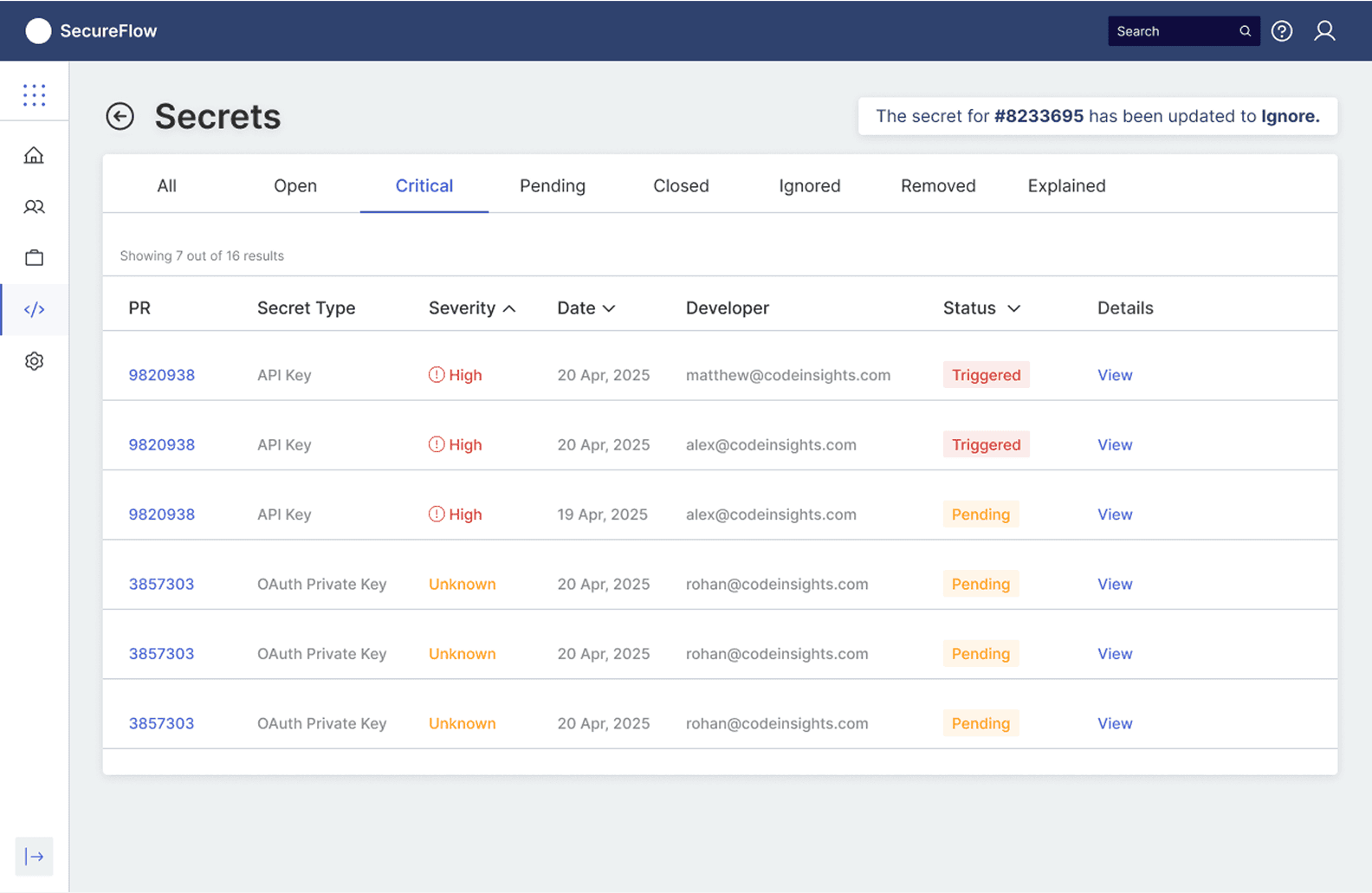
The secrets management flow was architected to preserve developer autonomy while ensuring organisational accountability, solving the critical tension between security enforcement and team morale. By providing granular visibility without creating a surveillance atmosphere, the design enables coaching conversations rather than punitive interventions, when a junior developer repeatedly commits OAuth tokens, the system surfaces this pattern for mentorship rather than disciplinary action.
The status-based filtering and severity classification system allows team leads to prioritise their limited attention on truly critical exposures while trusting their team to handle routine security maintenance independently. This design philosophy addresses the finding that junior developers' secret rates dropped 72% through passive learning opportunities embedded in the workflow, proving that contextual education outperforms enforcement.
The seamless escalation pathways ensure that unresolved high-risk secrets automatically surface to senior attention after 24 hours, creating a safety net that protects the organisation while maintaining developer trust and reducing the micromanagement burden on team leads.
The secrets management flow was architected to preserve developer autonomy while ensuring organisational accountability, solving the critical tension between security enforcement and team morale. By providing granular visibility without creating a surveillance atmosphere, the design enables coaching conversations rather than punitive interventions, when a junior developer repeatedly commits OAuth tokens, the system surfaces this pattern for mentorship rather than disciplinary action.
The status-based filtering and severity classification system allows team leads to prioritise their limited attention on truly critical exposures while trusting their team to handle routine security maintenance independently. This design philosophy addresses the finding that junior developers' secret rates dropped 72% through passive learning opportunities embedded in the workflow, proving that contextual education outperforms enforcement.
The seamless escalation pathways ensure that unresolved high-risk secrets automatically surface to senior attention after 24 hours, creating a safety net that protects the organisation while maintaining developer trust and reducing the micromanagement burden on team leads.
Security Improvements*
reduction in unresolved secrets.
reduction in unresolved secrets.
improvement in secret remediation rates.
improvement in secret remediation rates.
reduction in false positive alerts.
reduction in false positive alerts.
Developer Productivity*
reduction in pull request review time.
reduction in pull request review time.
reduction in security-related rollbacks.
reduction in security-related rollbacks.
reduction in repetitive security tasks.
reduction in repetitive security tasks.
The GitHub plugin's integrated solution architecture is designed to achieve these projected metric improvements through strategic workflow integration and intelligent automation. The inline annotation system eliminates context-switching penalties by embedding secret detection directly within GitHub's native interface, while machine learning models trained on resolved secrets dramatically improve signal-to-noise ratio by distinguishing between legitimate threats and false positives. Real-time feedback loops replace costly post-merge remediation with proactive prevention, enabling immediate issue resolution during code review. The team lead dashboard provides strategic visibility into security patterns, supporting data-driven interventions and automated escalation workflows that ensure systematic issue resolution.
*Estimated metrics
The GitHub plugin's integrated solution architecture is designed to achieve these projected metric improvements through strategic workflow integration and intelligent automation. The inline annotation system eliminates context-switching penalties by embedding secret detection directly within GitHub's native interface, while machine learning models trained on resolved secrets dramatically improve signal-to-noise ratio by distinguishing between legitimate threats and false positives. Real-time feedback loops replace costly post-merge remediation with proactive prevention, enabling immediate issue resolution during code review. The team lead dashboard provides strategic visibility into security patterns, supporting data-driven interventions and automated escalation workflows that ensure systematic issue resolution.
*Estimated metrics
Future Roadmap
IDE Integration: Proactive security suggestions and intelligent autocomplete that suggests secure alternatives during code creation.
Ecosystem Expansion: Integration with CI/CD pipelines and secret management systems.
AI-Powered Education: Personalised security training and contextual documentation based on individual developer patterns.
Compliance Automation: Automated audit reporting for enterprise customers.
Pattern Learning: Systems that learn from successful security implementations across organisations, suggesting proven secure patterns for common scenarios.
IDE Integration: Proactive security suggestions and intelligent autocomplete that suggests secure alternatives during code creation.
Ecosystem Expansion: Integration with CI/CD pipelines and secret management systems.
AI-Powered Education: Personalised security training and contextual documentation based on individual developer patterns.
Compliance Automation: Automated audit reporting for enterprise customers.
Pattern Learning: Systems that learn from successful security implementations across organisations, suggesting proven secure patterns for common scenarios.
Key Takeaways
SecureFlow represents my approach to solving complex technical challenges through user centered design. By focusing on developer experience while addressing critical security needs, this project demonstrates my ability to:
- Identify market opportunities through user research
- Design solutions that balance competing stakeholder needs
- Create technical architectures that scale across enterprise environments
This project showcases my evolution as a product designer capable of tackling sophisticated technical challenges while maintaining focus on user experience and business value. The methodologies and insights developed here continue to inform my approach to product design and strategic thinking.
SecureFlow represents my approach to solving complex technical challenges through user centered design. By focusing on developer experience while addressing critical security needs, this project demonstrates my ability to:
- Identify market opportunities through user research
- Design solutions that balance competing stakeholder needs
- Create technical architectures that scale across enterprise environments
This project showcases my evolution as a product designer capable of tackling sophisticated technical challenges while maintaining focus on user experience and business value. The methodologies and insights developed here continue to inform my approach to product design and strategic thinking.